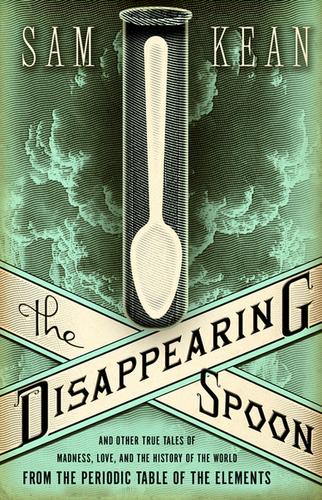
The Disappearing Spoon: And Other True Tales of Madness, Love, and the History of the World from the Periodic Table by Sam Kean is a 2010 science book about chemistry, scientific discovery, history of science. Every element in the periodic table has a discovery story, and most of them involve competition, nationalism, and more than a little personal recklessness.
Summary
The Disappearing Spoon is Sam Kean's account of how the periodic table of elements came to be — not as a dry exercise in classroom science, but as a record of obsession, accident, rivalry, and the occasional poisoning. The title comes from gallium, a metal with a melting point low enough that a spoon made from it dissolves in a cup of hot tea. That kind of detail, the property that makes an element strange and memorable, is what Kean builds each chapter around.
Kean moves roughly along the table's rows and columns but rarely in a straight line. He covers the race to synthesize and name new elements, the political dimension of science during the Cold War and the Manhattan Project, and the peculiar lives of the chemists and physicists who discovered these materials. Marie Curie's notebooks are still too radioactive to handle without protective gear. Fritz Haber won the Nobel Prize for the nitrogen-fixation process that feeds half the world and is also responsible for poison gas in World War I. These stories don't simplify the science or the ethics. They carry both.
The middle sections venture into biology and medicine: why mercury drives you mad, why iodine deficiency reshapes cognitive development across generations, how certain elements are essential in trace amounts and lethal in large ones. Kean writes about the body's elemental composition with the same enthusiasm he brings to the mad nineteenth-century quest for new metals. The chapters on lanthanides and actinides — the orphan rows at the bottom of every classroom table — are particularly good, recovering elements that most people have forgotten exist.
The book is popular science in the best sense: it assumes curiosity but not expertise, and it rewards both. Kean's research is thorough and his voice is informal without being glib. Readers who remember the periodic table mostly as a memorization exercise will find it transformed into something closer to a cast of characters, each with a history worth knowing.
Talk to The Disappearing Spoon: And Other True Tales of Madness, Love, and the History of the World from the Periodic Table like its author wrote you back.
Get the ideas that fit your life — not generic summaries.
- Chat with the book
- Audiobook-style main ideas
- Adapts to your life and goals
- Helps you take action
Key takeaways
- 1.
Every element in the periodic table has a discovery story, and most of them involve competition, nationalism, and more than a little personal recklessness.
- 2.
Gallium melts in hot water; mercury drives people mad; polonium kills with a touch. Physical properties are not just chemistry — they're biography.
- 3.
Mendeleev arranged the table with gaps where undiscovered elements should be, then predicted their properties. The predictions were so accurate they effectively forced the elements into existence.
- 4.
Fritz Haber's nitrogen-fixation process made artificial fertilizer possible, feeding billions, and the same chemistry later produced the poison gases of World War I. Single discoveries can have irreconcilable moral dimensions.
- 5.
The lanthanides and actinides, the two orphan rows below the main table, have uses ranging from smartphone screens to nuclear weapons — they are far from obscure in practice.
- 6.
Trace elements like iodine and selenium that are harmless or essential in small amounts can be toxic in excess. The line between nutrient and poison is often a matter of dose, not substance.
- 7.
The politics of naming elements was frequently petty and bitter, especially between American and Soviet scientists during the Cold War, when priority disputes over new synthetic elements lasted for decades.
- 8.
Marie Curie's personal research materials remain dangerously radioactive more than a century after her death, a physical reminder that scientific dedication can be indistinguishable from self-destruction.
Discussion questions
Use these on your own, with a book club, or as chat starters in Superbook. Book club version, ready to copy or print →
- 1.
Kean presents the periodic table as a record of human obsession. Which element's story struck you as the most surprising, and why?
- 2.
Fritz Haber is one of the book's most morally complicated figures. How do you reconcile a single career that both feeds billions and enables mass killing?
- 3.
Mendeleev predicted elements that hadn't been found yet. What does it say about scientific thinking that a conceptual framework could reveal something physical that hadn't yet been observed?
- 4.
Kean argues that the names of elements carry political baggage from the nations and eras that claimed them. Does that framing change how you think about familiar names like Americium or Californium?
- 5.
The book suggests that danger and discovery are closely linked — radium researchers dying slowly, chemists poisoned by their own work. What does that history imply about the risks people take in the name of knowledge?
- 6.
Which of the biographical portraits — Curie, Haber, the element hunters of the Cold War — felt most like a cautionary tale, and which felt like an inspiration?
- 7.
Kean spends considerable time on the elements that sustain human life in trace amounts. Did the section on biological elements change how you think about the connection between chemistry and health?
- 8.
The lanthanides and actinides are usually shown as detached footnotes on the periodic table. What do you think keeps them invisible in public understanding, given how heavily they're used in modern technology?
- 9.
The book's structure follows the table's logic — groups, periods, families. Did that structure help you as a reader, or would a purely chronological account have worked better?
- 10.
Several elements were named to honor nations during periods of nationalist competition. What do you think gets lost — or gained — when science becomes entangled with national prestige?
- 11.
Kean describes how certain toxic elements like mercury and lead were used for centuries in medicine, cosmetics, and paint before their dangers were understood. What does that pattern suggest about how we should approach newer materials today?
- 12.
The disappearing spoon trick using gallium is the book's central image. What's the value of using a single striking physical demonstration as a hook for a history this large?
Themes
Frequently asked questions
-
Is The Disappearing Spoon worth reading if I'm not a science person?
Yes. Kean writes as a storyteller first. The chemistry is there, but each chapter is really about the people and accidents behind the elements. Readers who remember the periodic table as an ordeal will find it entirely reimagined as a cast of eccentric characters.
-
How long does it take to read The Disappearing Spoon?
Around six hours at an average pace for the 400-page book. The chapters are relatively self-contained, so it works well in short sessions — you don't need to hold a continuous thread across the whole book.
-
What is The Disappearing Spoon actually about?
It's a history of the periodic table told through the stories of the people who discovered, named, and weaponized its elements. Kean covers everything from the Cold War race to synthesize new atoms to the biochemical reason mercury drives you mad.
-
Who should read this book?
Anyone who is curious about how scientific knowledge gets made, particularly those interested in the intersection of science, history, and biography. It's especially good for readers who want serious content without technical prerequisites.
-
What's the most memorable story in the book?
Most readers point to Fritz Haber — the chemist who won a Nobel Prize for feeding the world with synthetic fertilizer, then spent World War I developing and deploying poison gas. Kean doesn't soften the contradiction. It's one of the clearest illustrations in popular science of how a single discovery can have irreconcilable consequences.