Talk to The Distracted Mind like its author wrote you back.
Get the ideas that fit your life — not generic summaries.
- Chat with the book
- Audiobook-style main ideas
- Adapts to your life and goals
- Helps you take action
What it argues
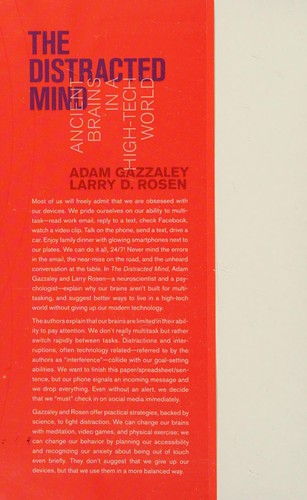
The Distracted Mind brings together two distinct research traditions — cognitive neuroscience and psychology of technology — to explain why modern humans find sustained attention so difficult and what can be done about it. Adam Gazzaley is a neuroscientist who studies the brain's attention and memory systems; Larry Rosen is a psychologist who studies how technology affects behavior. Their collaboration produces a book with more scientific grounding than most writing on distraction.
The first half of the book establishes the neuroscience. Human cognitive control — the executive functions that allow us to set goals, focus attention, and manage interference — is powerful but fundamentally limited. We have a high-level aspiration to perform complex tasks while maintaining goals over time, but a cognitive system that was designed for foraging and threat detection rather than sustained abstract work. The mismatch is the source of most distraction problems.
What it gets right
- 1.
The human brain has a fundamental mismatch: high-level goal complexity but limited cognitive control resources. This mismatch is the root cause of most distraction susceptibility.
- 2.
Goal interference is the mechanism by which competing demands degrade goal pursuit. The cognitive systems that maintain goals are the same ones that process interruptions — they cannot fully do both.
- 3.
Attention is not one thing. Selective attention, sustained attention, and divided attention are distinct capacities with different neural substrates and different failure modes.
What it covers
Who wrote it
Adam Gazzaley is a neuroscientist and professor at the University of California, San Francisco, where he directs the Gazzaley Lab, which studies cognitive control, aging, and human performance. He is also the co-founder of several neuroscience companies and has won multiple awards for his research. Larry D. Rosen is a research psychologist and Professor Emeritus of Psychology at California State University, Dominguez Hills, who has spent three decades studying the psychological effects of technology. The Distracted Mind, published in 2016, won several science communication awards.
