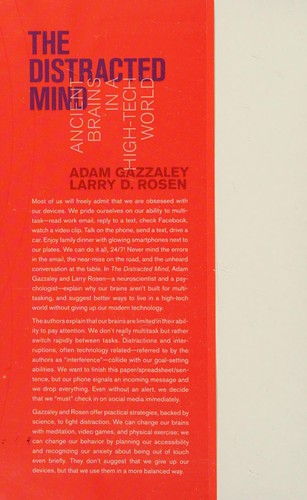
The Distracted Mind by Adam Gazzaley and Larry D. Rosen is a 2016 science book about attention, distraction, neuroscience. The human brain has a fundamental mismatch: high-level goal complexity but limited cognitive control resources. This mismatch is the root cause of most distraction susceptibility.
Summary
The Distracted Mind brings together two distinct research traditions — cognitive neuroscience and psychology of technology — to explain why modern humans find sustained attention so difficult and what can be done about it. Adam Gazzaley is a neuroscientist who studies the brain's attention and memory systems; Larry Rosen is a psychologist who studies how technology affects behavior. Their collaboration produces a book with more scientific grounding than most writing on distraction.
The first half of the book establishes the neuroscience. Human cognitive control — the executive functions that allow us to set goals, focus attention, and manage interference — is powerful but fundamentally limited. We have a high-level aspiration to perform complex tasks while maintaining goals over time, but a cognitive system that was designed for foraging and threat detection rather than sustained abstract work. The mismatch is the source of most distraction problems.
Gazzaley's research on the prefrontal cortex shows that the systems that manage goal-directed behavior are the same systems that process interruptions. They cannot fully do both simultaneously, which is why interruptions cost more than their duration. The concept of goal interference — the way competing goals and stimuli degrade the quality of goal pursuit — explains why open-plan offices, notification systems, and smartphone access reliably degrade knowledge work output.
The second half is more practical, addressing technology specifically. Rosen's research documents how smartphone checking has become habitual at intervals so short that the behavior is largely automatic. The book proposes a framework for modifying technology use: tech breaks, scheduled checking, environmental controls, and mindfulness practices that improve top-down attentional control. The prescriptions are familiar to readers of Newport or Bailey but grounded in more rigorous explanation.
Talk to The Distracted Mind like its author wrote you back.
Get the ideas that fit your life — not generic summaries.
- Chat with the book
- Audiobook-style main ideas
- Adapts to your life and goals
- Helps you take action
Key takeaways
- 1.
The human brain has a fundamental mismatch: high-level goal complexity but limited cognitive control resources. This mismatch is the root cause of most distraction susceptibility.
- 2.
Goal interference is the mechanism by which competing demands degrade goal pursuit. The cognitive systems that maintain goals are the same ones that process interruptions — they cannot fully do both.
- 3.
Attention is not one thing. Selective attention, sustained attention, and divided attention are distinct capacities with different neural substrates and different failure modes.
- 4.
Notifications don't just interrupt during their duration — they leave a cognitive residue of partially processed information that continues to interfere with goal pursuit for minutes afterward.
- 5.
Smartphone checking has become largely automatic for most heavy users, triggered by habitual cues rather than deliberate decision. The first step is interrupting the automaticity.
- 6.
Top-down attentional control — the ability to direct attention voluntarily toward what is relevant — can be trained and improved through mindfulness practice. This is one of the best-supported interventions in the attention literature.
- 7.
Technology breaks — brief, scheduled periods of permitted device checking — allow people to satisfy the pull of technology without allowing it to fragment focused work blocks.
- 8.
The distraction problem is partially neurological (limited cognitive control resources), partially developmental (habits formed during high-distraction periods), and partially environmental (systems designed to maximize interruption).
Discussion questions
Use these on your own, with a book club, or as chat starters in Superbook. Book club version, ready to copy or print →
- 1.
Gazzaley argues that our cognitive control systems are mismatched with modern knowledge work demands. Do you experience this mismatch? In what specific situations is it most acute?
- 2.
The book distinguishes selective, sustained, and divided attention. Which of these is your weakest capacity? What do you observe about yourself when it fails?
- 3.
Notifications leave a residue of interference even after they're cleared. What would it feel like to remove all notifications from your phone for two weeks?
- 4.
Rosen's research documents habitual phone-checking at short intervals. How often do you estimate you check your phone? Have you ever actually measured it?
- 5.
The top-down attention training most supported by the research is mindfulness practice. Have you ever had a consistent mindfulness practice? What effect did it have on your focus?
- 6.
Open-plan offices are designed partly for collaboration but produce documented attention fragmentation. What does your physical work environment do to your ability to focus?
- 7.
Technology breaks — scheduled checking windows — are the book's main recommendation for managing smartphone pull. What would that look like in your specific work situation?
- 8.
Gazzaley's research on aging and cognitive control suggests that attention systems deteriorate over time but are also more plastic than previously thought. What does that suggest about investing in attention training now?
- 9.
The book notes that the same brain systems that maintain goals also process interruptions. What does that suggest about the design of productive work environments?
- 10.
What has changed most about your own capacity for sustained attention in the last five years? What do you attribute that to?
- 11.
If you applied the science in this book rigorously — the environmental controls, the scheduled checking, the mindfulness practice — what would the biggest barrier to implementation be?
Themes
Frequently asked questions
-
Is The Distracted Mind worth reading?
Yes if you want a scientifically rigorous explanation for why distraction is so hard to overcome, not just practical tips. The neuroscience half is more demanding than most books in this space but genuinely illuminating. The practical half is less original but grounded in better evidence than most popular productivity writing.
-
How long does it take to read The Distracted Mind?
About four to five hours. The neuroscience sections reward slow reading; the practical sections move faster. The book is aimed at an educated general audience, not specialists.
-
What is the main idea of The Distracted Mind?
The human brain has a fundamental mismatch between the complexity of goals it can set and the fragility of the cognitive control systems that pursue them. Modern technology systematically exploits this mismatch. Understanding the neuroscience helps explain why common remedies fail and what actually works.
-
How does The Distracted Mind compare to Indistractable?
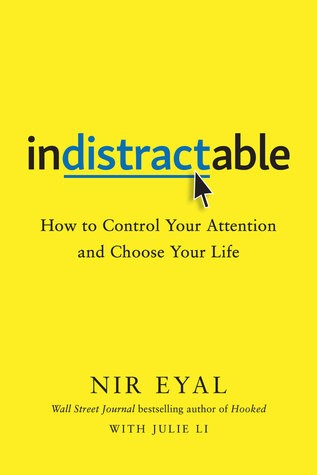
The Distracted Mind provides much deeper scientific grounding. Indistractable is more practically focused and more systematic in its action framework. For the why, read The Distracted Mind; for the how, Indistractable is more prescriptive.
-
Who should read The Distracted Mind?
People who want to understand distraction mechanistically, not just be told to use apps less. Also useful for researchers, educators, and managers who want to design environments for better cognitive performance rather than just managing their own.