Talk to The Double Helix like its author wrote you back.
Get the ideas that fit your life — not generic summaries.
- Chat with the book
- Audiobook-style main ideas
- Adapts to your life and goals
- Helps you take action
What it argues
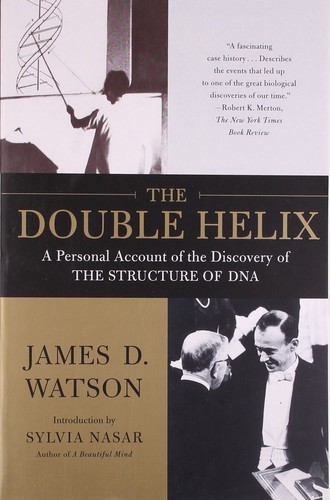
The Double Helix is James Watson's account of the race to determine the structure of DNA, which he and Francis Crick solved in 1953 at Cambridge. The book is written as a personal memoir rather than a scientific treatise: Watson describes the social world of postwar British science, his ambitions, his relationship with Crick, their rivals at King's College London — Rosalind Franklin and Maurice Wilkins — and the moment when a cardboard model of two intertwined helical chains resolved into something that looked unmistakably right.
The science at the center of the story is model-building. Watson and Crick were not doing wet-lab experiments but constructing physical models of possible DNA configurations and testing them against X-ray crystallography data generated by others. Franklin's X-ray photographs — particularly Photo 51, which Wilkins showed Watson without her knowledge — provided the critical experimental constraint that confirmed the helical structure. Watson's account of this episode is candid about the ethical murkiness without fully grappling with it: Franklin was not told her data was being used, and she received no co-authorship credit in the original Nature paper.
What it gets right
- 1.
The discovery of DNA's double-helix structure in 1953 was a product of model-building, crystallography data, and scientific competition as much as controlled experiment.
- 2.
Watson and Crick relied heavily on X-ray crystallography data generated by Rosalind Franklin and Maurice Wilkins — particularly Franklin's Photo 51 — without Franklin's knowledge or consent.
- 3.
Scientific competition, ego, and the desire for credit drove the pace of the research as much as intellectual curiosity. Watson is unusual in saying so openly.
What it covers
Who wrote it
James D. Watson is an American molecular biologist who, together with Francis Crick, proposed the double-helix model of DNA in 1953. He shared the 1962 Nobel Prize in Physiology or Medicine with Crick and Maurice Wilkins. Watson subsequently directed Cold Spring Harbor Laboratory for decades and helped launch the Human Genome Project. He has been a controversial figure throughout his career, most notably for statements on race and genetics that were widely condemned and led to the removal of his honorary titles at Cold Spring Harbor in 2019. The Double Helix remains his most widely read work.
