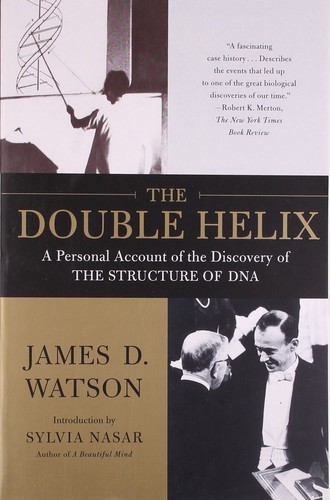
Talk to The Double Helix like its author wrote you back.
Get the ideas that fit your life — not generic summaries.
- Chat with the book
- Audiobook-style main ideas
- Adapts to your life and goals
- Helps you take action
The Double Helix, in detail
The Double Helix is James Watson's account of the race to determine the structure of DNA, which he and Francis Crick solved in 1953 at Cambridge. The book is written as a personal memoir rather than a scientific treatise: Watson describes the social world of postwar British science, his ambitions, his relationship with Crick, their rivals at King's College London — Rosalind Franklin and Maurice Wilkins — and the moment when a cardboard model of two intertwined helical chains resolved into something that looked unmistakably right.
The science at the center of the story is model-building. Watson and Crick were not doing wet-lab experiments but constructing physical models of possible DNA configurations and testing them against X-ray crystallography data generated by others. Franklin's X-ray photographs — particularly Photo 51, which Wilkins showed Watson without her knowledge — provided the critical experimental constraint that confirmed the helical structure. Watson's account of this episode is candid about the ethical murkiness without fully grappling with it: Franklin was not told her data was being used, and she received no co-authorship credit in the original Nature paper.
What makes the book unusual among science memoirs is its honesty about motivation. Watson makes no pretense of pure disinterested curiosity. He and Crick wanted to solve the structure before Linus Pauling, who had already proposed an incorrect three-chain model. The Nobel Prize was understood to be waiting. The social dynamics Watson describes — competitive, occasionally petty, fueled by scientific gossip and informal collaboration — bear little resemblance to the idealized picture of science as a cooperative search for truth.
The book provoked controversy on publication, particularly over its treatment of Franklin. Crick and Wilkins wrote formal objections to Watson's characterization of events. The scientific community has since largely acknowledged that Franklin's contribution was essential and inadequately credited. Read alongside those later reckonings, The Double Helix remains one of the most revealing portraits of how major science actually gets done.
The big ideas
- 1.
The discovery of DNA's double-helix structure in 1953 was a product of model-building, crystallography data, and scientific competition as much as controlled experiment.
- 2.
Watson and Crick relied heavily on X-ray crystallography data generated by Rosalind Franklin and Maurice Wilkins — particularly Franklin's Photo 51 — without Franklin's knowledge or consent.
- 3.
Scientific competition, ego, and the desire for credit drove the pace of the research as much as intellectual curiosity. Watson is unusual in saying so openly.
