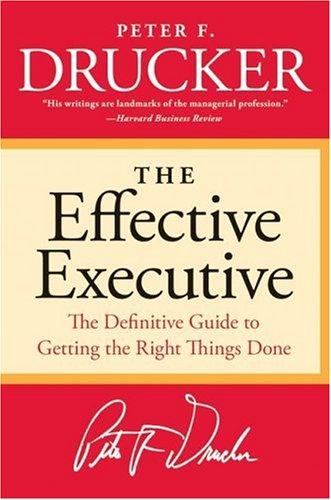
Talk to The Effective Executive like its author wrote you back.
Get the ideas that fit your life — not generic summaries.
- Chat with the book
- Audiobook-style main ideas
- Adapts to your life and goals
- Helps you take action
The Effective Executive, in detail
The Effective Executive is Peter Drucker's 1967 argument that effectiveness — getting the right things done — is a discipline that can be learned, and that it is the most important capability a knowledge worker can develop. The book is not about leadership in the inspirational sense. It's about practice: the habits, methods, and decisions that allow someone to convert their time and attention into results.
Drucker opens with the claim that intelligence, imagination, and knowledge are potential resources, but only effectiveness converts them into results. He then describes the five practices that effectiveness requires: managing time (knowing where time actually goes), focusing on contribution rather than effort, building on strengths rather than weaknesses, concentrating on the few decisive areas where superior performance produces outstanding results, and making effective decisions.
The time management chapter is among the most useful in the book. Drucker argues that executives systematically underestimate how much of their time is wasted on things that produce no results — meetings that resolve nothing, communication that transmits nothing, decisions that are made repeatedly because they weren't made properly the first time. He recommends tracking time in actual use, eliminating time wasters systematically, and consolidating the remaining discretionary time into large blocks for genuine concentration.
The decision-making chapter is the other major contribution. Drucker argues that effective decisions are made infrequently, deliberately, and at the right level of generality — they solve a class of problem rather than a single instance. He distinguishes between generic problems (requiring a rule or principle) and unique problems (requiring judgment), and argues that treating a generic problem as unique, or vice versa, is the most common decision-making error.
The big ideas
- 1.
Effectiveness is a discipline, not a talent. The practices that produce results can be identified, studied, and cultivated by anyone willing to do the work.
- 2.
Track your time in actual use, not as you imagine it. Most executives are shocked by how little of their time goes toward the work that matters most.
- 3.
Focus on contribution, not on effort. The question to ask is not 'what am I working on?' but 'what result do I owe this organization and these people?'
