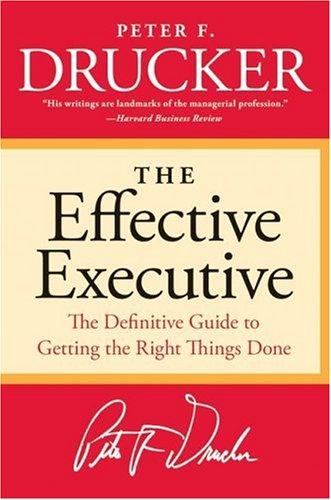
The Effective Executive by Peter F. Drucker is a 1967 business book about productivity, decision-making, time management. Effectiveness is a discipline, not a talent. The practices that produce results can be identified, studied, and cultivated by anyone willing to do the work.
Summary
The Effective Executive is Peter Drucker's 1967 argument that effectiveness — getting the right things done — is a discipline that can be learned, and that it is the most important capability a knowledge worker can develop. The book is not about leadership in the inspirational sense. It's about practice: the habits, methods, and decisions that allow someone to convert their time and attention into results.
Drucker opens with the claim that intelligence, imagination, and knowledge are potential resources, but only effectiveness converts them into results. He then describes the five practices that effectiveness requires: managing time (knowing where time actually goes), focusing on contribution rather than effort, building on strengths rather than weaknesses, concentrating on the few decisive areas where superior performance produces outstanding results, and making effective decisions.
The time management chapter is among the most useful in the book. Drucker argues that executives systematically underestimate how much of their time is wasted on things that produce no results — meetings that resolve nothing, communication that transmits nothing, decisions that are made repeatedly because they weren't made properly the first time. He recommends tracking time in actual use, eliminating time wasters systematically, and consolidating the remaining discretionary time into large blocks for genuine concentration.
The decision-making chapter is the other major contribution. Drucker argues that effective decisions are made infrequently, deliberately, and at the right level of generality — they solve a class of problem rather than a single instance. He distinguishes between generic problems (requiring a rule or principle) and unique problems (requiring judgment), and argues that treating a generic problem as unique, or vice versa, is the most common decision-making error.
Talk to The Effective Executive like its author wrote you back.
Get the ideas that fit your life — not generic summaries.
- Chat with the book
- Audiobook-style main ideas
- Adapts to your life and goals
- Helps you take action
Key takeaways
- 1.
Effectiveness is a discipline, not a talent. The practices that produce results can be identified, studied, and cultivated by anyone willing to do the work.
- 2.
Track your time in actual use, not as you imagine it. Most executives are shocked by how little of their time goes toward the work that matters most.
- 3.
Focus on contribution, not on effort. The question to ask is not 'what am I working on?' but 'what result do I owe this organization and these people?'
- 4.
Build on strengths — your own, your team's, and your organization's. Effective executives find people who are excellent at what is needed rather than trying to develop well-rounded performers.
- 5.
Concentration is the secret of economic results. The most effective executives do fewer things but do them at a deeper level of engagement than their less effective peers.
- 6.
Effective decisions are made infrequently and deliberately. Most decisions are generic and should be solved by a rule or principle, not by a fresh judgment each time.
- 7.
Start with what is right, not what is acceptable. A decision that fails to solve the right problem is worthless regardless of how well it was executed.
- 8.
First things first, second things not at all. The ability to set clear priorities and abandon low-priority work when higher priorities demand attention is central to executive effectiveness.
Discussion questions
Use these on your own, with a book club, or as chat starters in Superbook. Book club version, ready to copy or print →
- 1.
Drucker says the first step to effectiveness is tracking where your time actually goes. Have you ever done this honestly? What did you find?
- 2.
He distinguishes between doing work and contributing to results. In your current role, what is the specific contribution you owe — and how much of your time goes toward it?
- 3.
Drucker argues that most decisions are generic and should be solved by a rule rather than by fresh judgment each time. Which decisions in your role are you making repeatedly that you should instead solve once with a policy?
- 4.
Where are you building on weaknesses — your own or your team's — when you should instead be finding people who are strong in those areas? What's preventing that shift?
- 5.
Drucker says 'first things first, second things not at all.' What's on your current list that you keep moving to next week? Is it actually important, or does it just feel urgent?
- 6.
Think about the last significant meeting you attended. Did it produce a decision? Did it need to happen at all? What would Drucker say about it?
- 7.
Effective executives ask 'what is right?' before asking 'what is acceptable?' Think of a decision you made recently by working backward from what you thought would be approved. What would the right decision have been?
- 8.
Drucker wrote this in 1967. Which of his observations about executive time-wasting have gotten better with technology and which have gotten worse?
- 9.
What's the one area where, if you performed at your absolute best, the results would be transformative for your team or organization? How much of your time are you actually spending there?
- 10.
Drucker distinguishes generic from unique problems. What's a problem in your organization that is being treated as unique every time but is actually generic?
- 11.
What would your work look like if you eliminated everything you're doing that produces no results? Is the result more or less than you currently think?
- 12.
The book is about knowledge work, which Drucker defined more carefully than most. Is all of your work genuinely knowledge work, or are parts of it something else? Does that distinction matter for how you manage your time?
Themes
Frequently asked questions
-
Is The Effective Executive still relevant today?
Very much so. The book is about the fundamentals of converting time and attention into results, which has not changed despite the technology shifts. If anything, the distraction environment of the contemporary workplace makes the practices Drucker describes more necessary and more difficult than they were in 1967.
-
How long does it take to read The Effective Executive?
Around four hours for the 178-page book. Drucker writes in a dense, precise style. The book is short but rewards slow reading rather than skimming.
-
What is the most important idea in The Effective Executive?
Probably the distinction between effort and contribution. Drucker argues that effectiveness is about what you contribute to results, not how hard you work or how busy you are. This reframe is simple but uncomfortable, because it requires honestly asking whether your busyness is producing anything.
-
Who should read The Effective Executive?
Anyone in a knowledge worker role who wants to be more intentional about where they invest their attention. The title says 'executive' but the principles apply to any person whose job requires judgment and whose output is primarily intellectual.
-
How does The Effective Executive compare to Getting Things Done?
Getting Things Done is a system for managing the flow of tasks and commitments. The Effective Executive is about deciding which tasks and commitments to take on in the first place. They address different problems — Drucker is upstream of Allen. Both are worth reading; neither replaces the other.