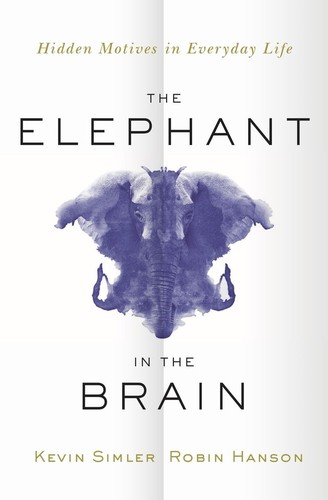
Talk to The Elephant in the Brain: Hidden Motives in Everyday Life like its author wrote you back.
Get the ideas that fit your life — not generic summaries.
- Chat with the book
- Audiobook-style main ideas
- Adapts to your life and goals
- Helps you take action
The Elephant in the Brain: Hidden Motives in Everyday Life, in detail
Kevin Simler and Robin Hanson argue that human behavior is much more self-interested and much less high-minded than the explanations people give for it. The title refers to the elephant in the room: the selfish, status-seeking, signaling motivations that drive most of what we do, which we collectively pretend not to notice because acknowledging them would be socially costly and individually uncomfortable.
The book makes a two-part argument. First, self-deception is adaptive. We evolved to misrepresent our own motives to ourselves and others because we are more convincing advocates for our own interests when we genuinely believe what we are saying. A person who sincerely believes they are helping a charity for purely altruistic reasons is a more effective fundraiser than one who knows they are doing it for social credit. The self-deception runs all the way down.
Second, most social behaviors are best understood as forms of signaling rather than as directly functional activities. Simler and Hanson apply this lens to consumption, art, education, medicine, religion, politics, and charitable giving. Higher education, on this account, is substantially a signaling mechanism — you spend four years demonstrating intelligence, diligence, and conformity, and the market rewards the signal, which is not the same as the actual learning. Medicine involves substantial placebo and signaling elements that explain why people continue to consume it beyond the point where clinical evidence supports its value.
The book is provocative and intended to be. Hanson in particular is known for arguments that prioritize the mechanistic over the moralistic. Some of the applications are stretched and the signaling explanation sometimes substitutes for rather than complements more nuanced accounts. But as a corrective to naive explanations of human behavior — as a prompt to ask "what is actually going on here?" — it is one of the more useful recent contributions to popular social psychology and behavioral economics.
The big ideas
- 1.
Self-deception is adaptive, not merely a failure. We evolved to misrepresent our own motives to ourselves because sincere belief makes us more persuasive advocates for our own interests.
- 2.
Most social behavior involves signaling — demonstrating qualities like intelligence, wealth, virtue, or commitment to attract mates, allies, and status. This signal function often explains behavior better than the surface rationale.
- 3.
The brain maintains hidden motives that serve self-interest but that we are not aware of and would deny if confronted. The book describes these as the elephant that the conscious rider cannot see.
