The Elephant in the Brain: Hidden Motives in Everyday Life by Kevin Simler and Robin Hanson is a 2018 psychology book about hidden motives, self-deception, social signaling. Self-deception is adaptive, not merely a failure. We evolved to misrepresent our own motives to ourselves because sincere belief makes us more persuasive advocates for our own interests.
Summary
Kevin Simler and Robin Hanson argue that human behavior is much more self-interested and much less high-minded than the explanations people give for it. The title refers to the elephant in the room: the selfish, status-seeking, signaling motivations that drive most of what we do, which we collectively pretend not to notice because acknowledging them would be socially costly and individually uncomfortable.
The book makes a two-part argument. First, self-deception is adaptive. We evolved to misrepresent our own motives to ourselves and others because we are more convincing advocates for our own interests when we genuinely believe what we are saying. A person who sincerely believes they are helping a charity for purely altruistic reasons is a more effective fundraiser than one who knows they are doing it for social credit. The self-deception runs all the way down.
Second, most social behaviors are best understood as forms of signaling rather than as directly functional activities. Simler and Hanson apply this lens to consumption, art, education, medicine, religion, politics, and charitable giving. Higher education, on this account, is substantially a signaling mechanism — you spend four years demonstrating intelligence, diligence, and conformity, and the market rewards the signal, which is not the same as the actual learning. Medicine involves substantial placebo and signaling elements that explain why people continue to consume it beyond the point where clinical evidence supports its value.
The book is provocative and intended to be. Hanson in particular is known for arguments that prioritize the mechanistic over the moralistic. Some of the applications are stretched and the signaling explanation sometimes substitutes for rather than complements more nuanced accounts. But as a corrective to naive explanations of human behavior — as a prompt to ask "what is actually going on here?" — it is one of the more useful recent contributions to popular social psychology and behavioral economics.
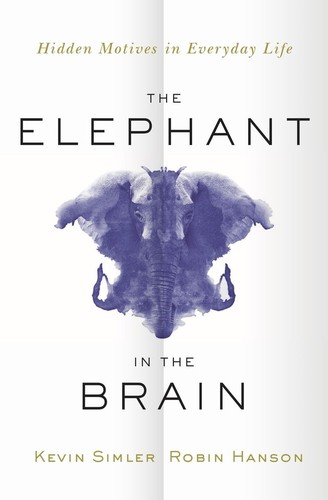
Talk to The Elephant in the Brain: Hidden Motives in Everyday Life like its author wrote you back.
Get the ideas that fit your life — not generic summaries.
- Chat with the book
- Audiobook-style main ideas
- Adapts to your life and goals
- Helps you take action
Key takeaways
- 1.
Self-deception is adaptive, not merely a failure. We evolved to misrepresent our own motives to ourselves because sincere belief makes us more persuasive advocates for our own interests.
- 2.
Most social behavior involves signaling — demonstrating qualities like intelligence, wealth, virtue, or commitment to attract mates, allies, and status. This signal function often explains behavior better than the surface rationale.
- 3.
The brain maintains hidden motives that serve self-interest but that we are not aware of and would deny if confronted. The book describes these as the elephant that the conscious rider cannot see.
- 4.
Education as signaling: a substantial portion of the economic return to higher education comes from credentials that signal compliance, intelligence, and effort — not from knowledge that is actually used on the job.
- 5.
Medicine as signaling: people consume far more medical care than clinical evidence suggests is beneficial because medicine signals care for oneself and one's family — a non-clinical value the market also prices.
- 6.
Politics as tribal signaling: political positions are often more about signaling group identity and loyalty than about holding carefully reasoned views. This explains why people hold consistent ideological packages on unrelated issues.
- 7.
Charitable giving and altruism have signaling components that are real even if not the whole story. Pure altruism in humans is rare; most benevolence also serves status and identity functions.
- 8.
Acknowledging hidden motives is socially punished, which is why the elephant stays in the room. Social norms enforce the official narratives even when everyone participating in them knows they are partly false.
Discussion questions
Use these on your own, with a book club, or as chat starters in Superbook. Book club version, ready to copy or print →
- 1.
The book argues that we are systematically self-deceived about our own motivations. What is your reaction to that claim? Do you find it liberating, deflating, or something else?
- 2.
Simler and Hanson apply the signaling lens to education. Does that analysis match your experience of school and college, and what does it suggest about what education actually is for?
- 3.
They argue that medicine is partly a signaling good. How do you distinguish the signaling components of medical consumption from the genuinely therapeutic? Does it matter?
- 4.
The book says that political positions are often more about tribal identity than reasoned analysis. Can you identify a position you hold where you have not seriously examined the evidence?
- 5.
If self-deception is adaptive, what is the cost of becoming more honest with yourself about your motives? Does the book suggest that becoming less self-deceived is beneficial?
- 6.
Hanson has been criticized for over-applying the signaling explanation. Are there cases in the book where you think the signaling account misses something important?
- 7.
The book argues that most people know, at some level, that official explanations are partly false but maintain them because the social norm demands it. Is there a setting in your life where this is most visible?
- 8.
They claim that art consumption is substantially about signaling taste and affiliation rather than pure aesthetic experience. What is your reaction to this reading of something you care about?
- 9.
If employers are paying for credentials as signals rather than competence, what are the implications for how education should be structured?
- 10.
Is there a hidden motive you have recognized in yourself after reading this book — something you were doing for self-interested reasons while telling yourself a different story?
- 11.
How does the elephant-in-the-brain framework interact with concepts like integrity and authenticity? Is it possible to be authentic in a world where most motivation is partly concealed from the self?
Themes
Frequently asked questions
-
Is this book cynical about human nature?
The authors would say realistic rather than cynical. They argue that acknowledging hidden motives does not make behavior less valuable or meaningful — signaling can produce real goods even if the primary driver is status. But the book does ask readers to give up some flattering self-narratives.
-
What is the signaling theory of education?
The hypothesis that a substantial portion of the economic return to higher education comes from demonstrating intelligence, diligence, and conformity to employers — not from acquiring skills or knowledge that is directly applied. Bryan Caplan's The Case Against Education develops this at length; Simler and Hanson cover it as part of a broader argument.
-
Is the book well-evidenced?
It draws on evolutionary psychology, behavioral economics, and social psychology research. Some applications are speculative and the signaling explanation is applied more aggressively than the evidence strictly supports in some cases. It is a provocative hypothesis book more than a definitive empirical account.
-
Does the self-deception claim apply equally to everyone?
The authors argue it is a general feature of the evolved human mind, not a trait of certain people. Introspection can reduce the degree of self-deception, but probably not eliminate it.
-
What is the most important practical implication?
Asking 'what is actually going on here?' rather than accepting official explanations. In institutions, relationships, and your own behavior, treating stated motives as incomplete rather than complete is often a more accurate starting point.
Similar books
Misbehaving: The Making of Behavioral Economics
Richard H. Thaler

The Social Animal
Elliot Aronson
Subliminal: How Your Unconscious Mind Rules Your Behavior
Leonard Mlodinow
Mistakes Were Made (But Not by Me)
Carol Tavris and Elliot Aronson
