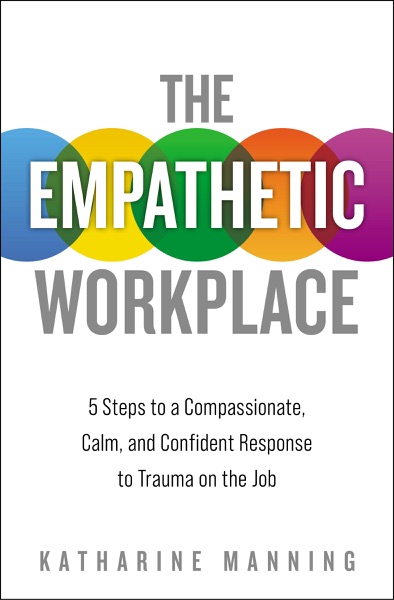
Talk to The Empathetic Workplace like its author wrote you back.
Get the ideas that fit your life — not generic summaries.
- Chat with the book
- Audiobook-style main ideas
- Adapts to your life and goals
- Helps you take action
The Empathetic Workplace, in detail
The Empathetic Workplace is Katharine Manning's guide to responding effectively when employees, colleagues, or clients bring personal crises, trauma, or distress into professional settings. Manning argues that this happens far more often than most leaders expect — and that the typical workplace response, which ranges from awkward dismissal to overreach, makes things worse for everyone involved.
Manning spent two decades as a legal advisor at the U.S. Department of Justice, helping crime victims navigate a complex system. That experience shapes the book's practical core: a five-step framework she calls LASER (Listen, Acknowledge, Share, Empower, Return). The framework is designed to let anyone — manager, HR professional, or peer — respond to a disclosure in a way that validates the person without turning the conversation into amateur therapy or creating legal liability.
The book covers the full range of what employees bring to work: sexual harassment, domestic violence, addiction, grief, mental illness, financial crisis, and trauma from events like natural disasters or community violence. Manning doesn't argue that employers should become social service agencies. Her claim is narrower and more defensible: when leaders respond poorly to employees in distress, they lose the person's trust, reduce their productivity, and often accelerate the departure of a talented employee who might have stayed if someone had just listened properly.
The writing is direct and case-study heavy. Manning draws on real situations she encountered in federal service, stripping identifying details. The result is a book that reads less like a leadership manifesto and more like a training manual — which is both its strength and its limitation. Readers who want philosophical depth on empathy will find it sparse. Those who want concrete guidance on what to say in a hard conversation will find it genuinely useful.
The big ideas
- 1.
Employees bring crises to work whether you invite them to or not. The question is whether your response helps or harms the situation.
- 2.
The LASER framework (Listen, Acknowledge, Share, Empower, Return) gives leaders a repeatable structure for responding to disclosures without overstepping.
- 3.
Listening without judgment is a skill, not a personality trait. Most people interrupt, give advice, or redirect too quickly when a colleague is in distress.
