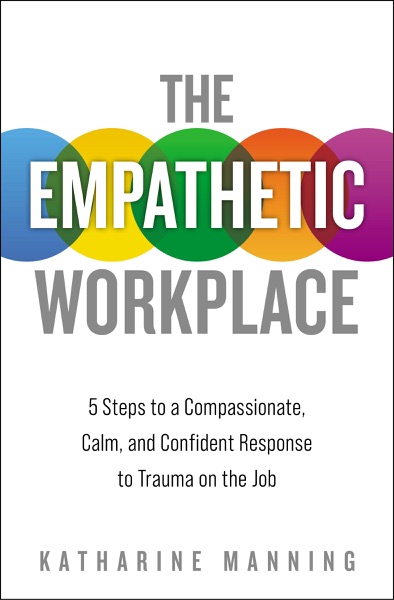
The Empathetic Workplace by Katharine Manning is a 2021 business book about empathy, workplace trauma, leadership. Employees bring crises to work whether you invite them to or not. The question is whether your response helps or harms the situation.
Summary
The Empathetic Workplace is Katharine Manning's guide to responding effectively when employees, colleagues, or clients bring personal crises, trauma, or distress into professional settings. Manning argues that this happens far more often than most leaders expect — and that the typical workplace response, which ranges from awkward dismissal to overreach, makes things worse for everyone involved.
Manning spent two decades as a legal advisor at the U.S. Department of Justice, helping crime victims navigate a complex system. That experience shapes the book's practical core: a five-step framework she calls LASER (Listen, Acknowledge, Share, Empower, Return). The framework is designed to let anyone — manager, HR professional, or peer — respond to a disclosure in a way that validates the person without turning the conversation into amateur therapy or creating legal liability.
The book covers the full range of what employees bring to work: sexual harassment, domestic violence, addiction, grief, mental illness, financial crisis, and trauma from events like natural disasters or community violence. Manning doesn't argue that employers should become social service agencies. Her claim is narrower and more defensible: when leaders respond poorly to employees in distress, they lose the person's trust, reduce their productivity, and often accelerate the departure of a talented employee who might have stayed if someone had just listened properly.
The writing is direct and case-study heavy. Manning draws on real situations she encountered in federal service, stripping identifying details. The result is a book that reads less like a leadership manifesto and more like a training manual — which is both its strength and its limitation. Readers who want philosophical depth on empathy will find it sparse. Those who want concrete guidance on what to say in a hard conversation will find it genuinely useful.
Talk to The Empathetic Workplace like its author wrote you back.
Get the ideas that fit your life — not generic summaries.
- Chat with the book
- Audiobook-style main ideas
- Adapts to your life and goals
- Helps you take action
Key takeaways
- 1.
Employees bring crises to work whether you invite them to or not. The question is whether your response helps or harms the situation.
- 2.
The LASER framework (Listen, Acknowledge, Share, Empower, Return) gives leaders a repeatable structure for responding to disclosures without overstepping.
- 3.
Listening without judgment is a skill, not a personality trait. Most people interrupt, give advice, or redirect too quickly when a colleague is in distress.
- 4.
Acknowledging what someone is going through — without trying to fix it — is often the most useful thing a leader can do in the first five minutes.
- 5.
Empowering someone in crisis means returning agency to them: asking what they need rather than deciding what they should do.
- 6.
Organizations that handle distress well retain employees longer and build the psychological safety that enables honest communication about other issues.
- 7.
Secondary trauma is real. Leaders who regularly hear difficult disclosures need to build their own support systems to avoid emotional depletion.
- 8.
Most people don't need a referral, they need to feel heard first. Jumping straight to resources skips the human step that makes everything else work.
Discussion questions
Use these on your own, with a book club, or as chat starters in Superbook. Book club version, ready to copy or print →
- 1.
Think of a time someone came to you with a personal crisis at work. Looking back, what did you do well and what would you do differently now?
- 2.
Manning argues most workplaces handle distress poorly by default. What patterns from your own organization do you recognize in her examples?
- 3.
Which step of the LASER framework would be hardest for you personally, and why?
- 4.
How do you distinguish between being supportive and overstepping into territory that requires professional help?
- 5.
Manning points out that people from marginalized groups are less likely to disclose distress at work. What barriers exist in your environment?
- 6.
What organizational practices — meeting rhythms, performance review design, HR processes — make it harder or easier to respond to employees in crisis?
- 7.
Secondary trauma affects people who regularly hear distressing stories. How does your team or organization support people in those roles?
- 8.
Have you ever been on the receiving end of a particularly good or particularly bad response when you shared something difficult at work? What made the difference?
- 9.
Manning says 'empowering' someone means giving back agency rather than directing their next steps. How does that change how you'd handle a specific real situation you've faced?
- 10.
When does organizational empathy risk becoming performative rather than genuine? What would be the warning signs?
- 11.
What specific change to onboarding, management training, or team norms in your organization would make the biggest practical difference for distressed employees?
- 12.
Manning's background is in trauma-informed legal advocacy. How does framing this as a legal and organizational risk, not just a moral one, change the conversation in your context?
Themes
Frequently asked questions
-
What is The Empathetic Workplace about?
It's a practical guide for managers and leaders on how to respond when employees or colleagues disclose personal crises — trauma, grief, abuse, addiction, or other distress — in professional settings. Manning gives a step-by-step framework drawn from her two decades in federal victim advocacy.
-
Who should read The Empathetic Workplace?
Managers, HR professionals, and anyone who regularly has one-on-one conversations with colleagues. It's especially relevant for organizations in high-stress fields, those undergoing major change, or anyone managing teams through crises.
-
Is The Empathetic Workplace worth reading?
Yes, if you want concrete guidance on a topic most leadership books either skip or treat abstractly. Manning's LASER framework is practical and grounded in real experience. Readers looking for philosophical depth on empathy will want to look elsewhere — the book is a handbook, not a treatise.
-
What is the LASER framework in this book?
LASER stands for Listen, Acknowledge, Share, Empower, Return. It's Manning's five-step process for responding to an employee disclosure in a way that validates the person, preserves their agency, and keeps the conversation professional without being cold.
-
How long does it take to read The Empathetic Workplace?
About four to five hours for the 240-page book. The chapters are organized around specific scenarios, so it also works as a reference — you can read the section most relevant to a current situation without reading cover to cover.
Similar books
Dare to Lead
Brené Brown
Radical Candor
Kim Scott
Crucial Conversations: Tools for Talking When Stakes Are High
Kerry Patterson, Joseph Grenny, Ron McMillan, and Al Switzler
The Culture Code
Daniel Coyle
