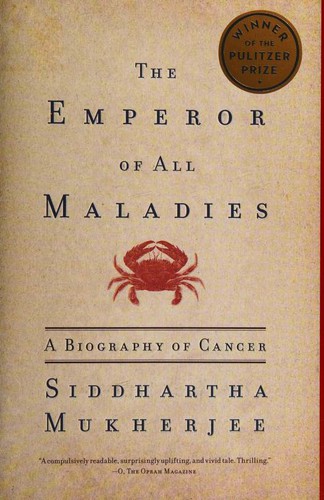
Talk to The Emperor of All Maladies: A Biography of Cancer like its author wrote you back.
Get the ideas that fit your life — not generic summaries.
- Chat with the book
- Audiobook-style main ideas
- Adapts to your life and goals
- Helps you take action
What it argues
The Emperor of All Maladies is Siddhartha Mukherjee's account of cancer from antiquity to the present — its biology, its treatments, its false dawns, and the scientists and patients caught in the middle of each. Mukherjee, an oncologist and researcher, wrote much of the book while treating patients at a Boston hospital, and that proximity to the disease shows. This is not a triumphalist history of medicine. It is a clear-eyed account of how long it has taken humanity to understand something that has been killing people since before recorded time.
The structure moves roughly chronologically. Mukherjee begins with ancient Egyptian papyri describing tumors and ends with the molecular biology of the early 2000s. Along the way he traces the rise and fall of radical surgery — the Halsted mastectomy, which disfigured thousands of women based on a theory that turned out to be wrong — and the development of chemotherapy, which emerged partly from military research into mustard gas. He is particularly sharp on the period between the 1950s and 1980s, when oncologists fought bitterly over competing treatment philosophies while the underlying biology remained largely mysterious. The war on cancer, declared by Nixon in 1971, is shown as a political event as much as a scientific one.
What it gets right
- 1.
Cancer is not one disease but hundreds, each driven by distinct genetic mutations. Treatments that work for one cancer may be useless or harmful for another.
- 2.
The history of cancer treatment is littered with interventions — like radical mastectomy — that were widely practiced for decades based on incorrect theories, often at great cost to patients.
- 3.
Chemotherapy emerged from military research: nitrogen mustard, a chemical weapon, was the precursor to the first cancer drugs. The line between poison and treatment is a matter of dosage and targeting.
What it covers
Who wrote it
Siddhartha Mukherjee is an oncologist, researcher, and author based at Columbia University, where he studies cancer biology and stem cell science. Born in New Delhi, he trained at Stanford, Oxford, and Harvard Medical School. The Emperor of All Maladies, his first book, won the Pulitzer Prize for General Nonfiction in 2011 and was adapted into a documentary by Ken Burns. His subsequent books include The Laws of Medicine and The Gene: An Intimate History, a wide-ranging account of genetics and heredity. He writes regularly for The New Yorker and remains a practicing oncologist.
