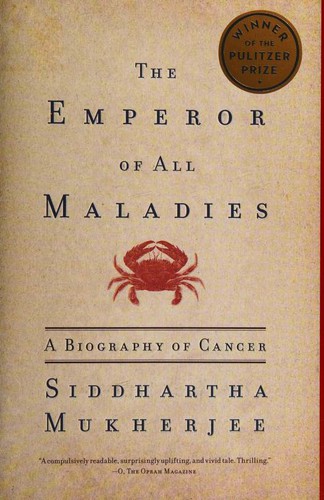
The Emperor of All Maladies: A Biography of Cancer by Siddhartha Mukherjee is a 2010 science book about cancer, medical history, science. Cancer is not one disease but hundreds, each driven by distinct genetic mutations. Treatments that work for one cancer may be useless or harmful for another.
Summary
The Emperor of All Maladies is Siddhartha Mukherjee's account of cancer from antiquity to the present — its biology, its treatments, its false dawns, and the scientists and patients caught in the middle of each. Mukherjee, an oncologist and researcher, wrote much of the book while treating patients at a Boston hospital, and that proximity to the disease shows. This is not a triumphalist history of medicine. It is a clear-eyed account of how long it has taken humanity to understand something that has been killing people since before recorded time.
The structure moves roughly chronologically. Mukherjee begins with ancient Egyptian papyri describing tumors and ends with the molecular biology of the early 2000s. Along the way he traces the rise and fall of radical surgery — the Halsted mastectomy, which disfigured thousands of women based on a theory that turned out to be wrong — and the development of chemotherapy, which emerged partly from military research into mustard gas. He is particularly sharp on the period between the 1950s and 1980s, when oncologists fought bitterly over competing treatment philosophies while the underlying biology remained largely mysterious. The war on cancer, declared by Nixon in 1971, is shown as a political event as much as a scientific one.
The molecular biology chapters are where Mukherjee's prose hits a different register. When he explains oncogenes, tumor suppressor genes, and the genomic logic of how a normal cell becomes cancerous, the writing slows down and becomes genuinely illuminating. The discovery that cancer is not one disease but hundreds — each driven by different genetic mutations — is presented not as a footnote but as the central shift in how oncology thinks. This reframing from "cancer" to "cancers" is still reshaping treatment today, and Mukherjee traces how that understanding emerged.
The book won the Pulitzer Prize in 2011, and the recognition is warranted. Mukherjee balances scientific depth with narrative momentum. His patients are named and specific, not illustrative abstractions. The book does not resolve into optimism — cancer remains, as he writes, "an emperor of all maladies" — but it does leave a reader with a clearer understanding of why the disease is so difficult to beat, and what it has taken to make any progress at all. For anyone who has had cancer touch their life, or who simply wants to understand what modern medicine can and cannot do, this is the most thorough account available.
Talk to The Emperor of All Maladies: A Biography of Cancer like its author wrote you back.
Get the ideas that fit your life — not generic summaries.
- Chat with the book
- Audiobook-style main ideas
- Adapts to your life and goals
- Helps you take action
Key takeaways
- 1.
Cancer is not one disease but hundreds, each driven by distinct genetic mutations. Treatments that work for one cancer may be useless or harmful for another.
- 2.
The history of cancer treatment is littered with interventions — like radical mastectomy — that were widely practiced for decades based on incorrect theories, often at great cost to patients.
- 3.
Chemotherapy emerged from military research: nitrogen mustard, a chemical weapon, was the precursor to the first cancer drugs. The line between poison and treatment is a matter of dosage and targeting.
- 4.
The 'war on cancer' declared by Nixon in 1971 raised expectations far beyond what the science could deliver, and the gap between political promise and biological reality shaped oncology for a generation.
- 5.
Oncogenes are mutated versions of normal genes that regulate cell growth. When these mutations accumulate, a cell loses the checks on replication and cancer begins.
- 6.
Targeted therapies like Gleevec, designed to block a specific molecular pathway in chronic myeloid leukemia, showed that understanding cancer's genetic drivers could produce drugs with dramatically better outcomes and fewer side effects.
- 7.
Screening and prevention — for lung cancer via cigarette regulation, for cervical cancer via the Pap smear — have saved more lives than many treatments. Mukherjee argues that the history of prevention is systematically undervalued.
- 8.
Progress in oncology has come in fits and starts, shaped as much by institutional politics, funding cycles, and scientific fashion as by the logic of the science itself.
Discussion questions
Use these on your own, with a book club, or as chat starters in Superbook. Book club version, ready to copy or print →
- 1.
Mukherjee describes radical mastectomy as a treatment that caused enormous harm before its theoretical basis was disproven. How should medicine handle widespread practices that lack solid evidence?
- 2.
The war on cancer was a political declaration before it was a scientific strategy. When does government funding accelerate research, and when does it distort it?
- 3.
Cancer turned out to be not one disease but hundreds. How does this reframing change what it means to say we are 'winning' or 'losing' against cancer?
- 4.
Mukherjee's patients are present throughout the book. How did their presence change your reading of the scientific history?
- 5.
The discovery of Gleevec as a targeted therapy felt like proof of a new paradigm. Why hasn't that paradigm produced equally dramatic results for most other cancers?
- 6.
Prevention — the Pap smear, antismoking campaigns — seems more impactful than treatment in many cases. Why does medicine, and the public, tend to focus more on cures than on prevention?
- 7.
Mukherjee is an oncologist writing about a disease he treats daily. How does that position shape what he chooses to emphasize, and what he might leave out?
- 8.
Several scientists in the book were wrong for decades but still advanced the field in important ways. What does that suggest about how scientific progress actually works?
- 9.
The book ends without a resolution. Cancer has not been conquered. How do you sit with an account of a struggle that has no clear endpoint?
- 10.
Which figure in the history Mukherjee tells do you find most compelling — and which do you find hardest to sympathize with?
- 11.
Mukherjee writes about the emotional experience of giving a patient a terminal diagnosis. How should doctors communicate uncertainty when patients want certainty?
- 12.
If you or someone close to you has experienced cancer, did reading this book change how you understood that experience?
Themes
Frequently asked questions
-
Is The Emperor of All Maladies worth reading?
Yes, particularly if you want to understand why cancer is so difficult to treat or have been touched by the disease personally. The book combines scientific rigor with narrative skill, and Mukherjee's background as a practicing oncologist keeps it grounded in clinical reality. Some sections on early chemotherapy history are dense, but the molecular biology chapters are exceptionally clear.
-
How long does it take to read The Emperor of All Maladies?
Around eleven to twelve hours at average reading pace for the 470-page book. It rewards slow reading — the historical sections build on each other, and the science in the later chapters is clearer if you've followed the earlier narrative carefully.
-
What is The Emperor of All Maladies about?
It is a comprehensive history of cancer — from ancient Egypt through molecular oncology — told through the scientists who studied it, the doctors who treated it, and the patients who lived and died with it. Mukherjee's central argument is that cancer is as old as life itself, and that understanding it has required rethinking the very nature of cellular biology.
-
Who should read The Emperor of All Maladies?
Anyone who wants a rigorous, human account of how modern oncology developed. It is especially relevant for people who have had cancer affect their family, for medical students, and for anyone interested in how science actually advances — including its false starts and political entanglements.
-
What is the most important idea in the book?
That cancer is not one disease but a family of diseases each driven by different genetic mutations, and that this understanding — which took decades to establish — is the foundation of every promising modern treatment. The shift from treating 'cancer' to treating specific molecular subtypes is Mukherjee's clearest throughline.
Similar books
When Breath Becomes Air
Paul Kalanithi
The Immortal Life of Henrietta Lacks
Rebecca Skloot
Outlive: The Science and Art of Longevity
Peter Attia
Lifespan: Why We Age—and Why We Don't Have To
David A. Sinclair
