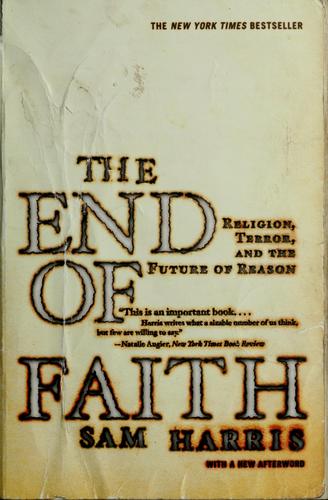
Talk to The End of Faith: Religion, Terror, and the Future of Reason like its author wrote you back.
Get the ideas that fit your life — not generic summaries.
- Chat with the book
- Audiobook-style main ideas
- Adapts to your life and goals
- Helps you take action
The End of Faith: Religion, Terror, and the Future of Reason, in detail
The End of Faith was written in the weeks following the September 11 attacks and published in 2004. It is Sam Harris' first book and his most urgent — a sustained argument that religious faith, understood as belief without sufficient evidence, is uniquely dangerous because it places certain conclusions beyond rational examination and can therefore motivate any act in their service. Harris' target is not only Islamic extremism but religious faith as such, including the moderate religious belief that, he argues, provides the cultural cover under which extremism thrives.
The book's argument has several layers. The epistemological layer: faith — believing things on insufficient evidence — is an irresponsible cognitive practice that, when applied to political questions, generates catastrophic results. The historical layer: the history of religious violence is not an aberration but a predictable consequence of ideologies that treat certain beliefs as literally sacred and non-negotiable. The cultural layer: the West's embarrassment about criticizing religious belief — its deference to faith as a special category exempt from the standards of evidence applied to other claims — is itself a problem that facilitates religious extremism.
The book's treatment of Islam is more extensive and more critical than its treatment of Christianity and Judaism, reflecting its post-9/11 context. Harris argues that the specific doctrines of mainstream Islam — concerning martyrdom, apostasy, and jihad — are more directly connected to political violence than equivalent doctrines in contemporary Christianity, and that this difference matters for policy analysis. This argument generated substantial controversy and has been revisited in his subsequent work.
The final chapter, on ethics, proposes a science of morality based on facts about wellbeing rather than divine command or cultural consensus. This argument is developed more fully in The Moral Landscape (2010) but its initial statement here is forceful. Harris argues that the collapse of religious ethics will not leave a vacuum but will create space for a more honest engagement with what actually produces or reduces suffering.
The big ideas
- 1.
Faith — belief on insufficient evidence — is an epistemically irresponsible practice that, when applied to political and moral questions, produces uniquely dangerous results.
- 2.
Moderate religious belief provides cultural legitimacy to the idea that certain commitments are beyond rational examination, creating conditions in which extremism can grow.
- 3.
The history of religious violence is not a series of aberrations but a predictable consequence of ideologies that treat certain beliefs as literally sacred.
