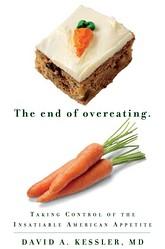
Talk to The End of Overeating like its author wrote you back.
Get the ideas that fit your life — not generic summaries.
- Chat with the book
- Audiobook-style main ideas
- Adapts to your life and goals
- Helps you take action
The End of Overeating, in detail
David Kessler, a former FDA commissioner and dean of two medical schools, wrote The End of Overeating as a scientific investigation into why so many people — including himself — find it nearly impossible to stop eating hyperpalatable food once they start. Drawing on neuroscience, food industry research, animal behavior studies, and interviews with food scientists and restaurant developers, Kessler builds a case that overeating in modern environments is not a failure of character but a predictable neurological response to engineered stimuli.
Kessler's central mechanism is the cue-urge-reward-habit loop. Certain foods — particularly those engineered around combinations of sugar, fat, and salt — activate dopamine circuits in the brain with unusual intensity. Over time, exposure to these foods trains the brain to respond to associated cues (the smell of a restaurant, a particular time of day, seeing an advertisement) with a craving urge that competes directly with the prefrontal cortex's capacity for self-regulation. The stronger the habit loop becomes, the harder it is to interrupt, regardless of how clearly someone understands what is happening.
The food industry section of the book is reported in a similar vein to Moss's Salt Sugar Fat, though it came first. Kessler documents how restaurant chains and packaged food companies deliberately engineer for "cravability" — layering fats on sugar on salt, maximizing variety and contrast within a single product, and designing textures that melt in the mouth quickly so the brain doesn't register satiety before the next bite arrives. He traces how this engineering became standard practice and how it spread from fast food into mainstream cuisine.
The final section is the most practical. Kessler proposes a framework he calls "food rehab" — not a diet but a cognitive and behavioral restructuring that treats hyperpalatable food as a genuine stimulus that requires specific counter-conditioning. The prescription includes defining which foods are personally problematic, building structured eating patterns that reduce exposure to cues, and developing replacement narratives for moments of temptation. It is more cognitive-behavioral therapy than nutrition advice, which is appropriate given the diagnosis.
The big ideas
- 1.
Overeating is not primarily a willpower failure — it is a predictable neurological response to foods engineered to overwhelm the brain's satiety signals.
- 2.
The cue-urge-reward-habit loop, driven by dopamine, is the same mechanism that underlies other addictive behaviors. Hyperpalatable food activates it reliably.
- 3.
Food companies deliberately engineer products to maximize cravability through layered combinations of salt, sugar, and fat, and through textures that prevent satiety.
