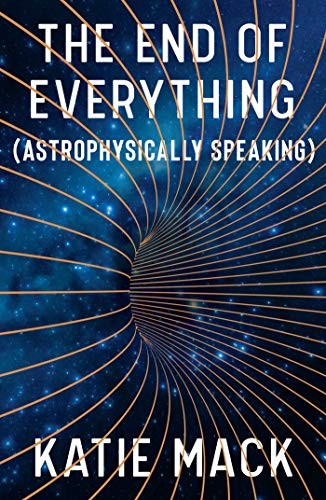
Talk to The End of Everything (Astrophysically Speaking) like its author wrote you back.
Get the ideas that fit your life — not generic summaries.
- Chat with the book
- Audiobook-style main ideas
- Adapts to your life and goals
- Helps you take action
The End of Everything (Astrophysically Speaking), in detail
The End of Everything is cosmologist Katie Mack's tour through the five leading theories about how the universe will eventually cease to exist. The scenarios range from the merely disturbing — a slow decay into cold emptiness over trillions of years — to the cosmically violent: a phase transition in the quantum vacuum that could erase everything in an instant. Mack writes with warmth and dry wit, making the subject feel less like an existential threat and more like a fascinating unsolved physics problem.
The book covers the Big Crunch, Heat Death, the Big Rip, Vacuum Decay, and the Bounce. Each scenario follows from different assumptions about the universe's energy content, the behavior of dark energy, and the stability of the quantum vacuum. Mack is careful to distinguish between scenarios that are physically ruled out and those that remain live possibilities — she treats the reader as capable of handling genuine scientific uncertainty rather than demanding a clean answer.
Much of the book's appeal comes from what it explains along the way. To understand how the universe might end, readers need to understand dark energy, inflation, the cosmic microwave background, and quantum field theory at a conceptual level. Mack builds these ideas efficiently, using them as scaffolding for the end-state scenarios rather than padding the book with standalone explainers.
Mack is also candid about what scientists don't know. The ultimate fate depends on measurements — the precise value of dark energy, whether it changes over time, the stability of the Higgs field — that remain uncertain. The book's honesty about this is one of its strengths. It ends not with false comfort but with genuine intellectual wonder: the universe is doing something extraordinary, and the fact that we can figure out roughly how it ends is itself remarkable.
The big ideas
- 1.
The universe has at least five plausible endings: Big Crunch, Heat Death, Big Rip, Vacuum Decay, and the Bounce — each following from different assumptions about dark energy.
- 2.
Heat Death is currently the most favored scenario: as the universe expands, galaxies drift apart, stars burn out, and the cosmos approaches a state of maximum entropy and near-zero usable energy.
- 3.
Dark energy — a repulsive force driving accelerated expansion — is the dominant factor in determining the universe's fate, and its precise nature remains unknown.
