Talk to The Extended Mind like its author wrote you back.
Get the ideas that fit your life — not generic summaries.
- Chat with the book
- Audiobook-style main ideas
- Adapts to your life and goals
- Helps you take action
What it argues
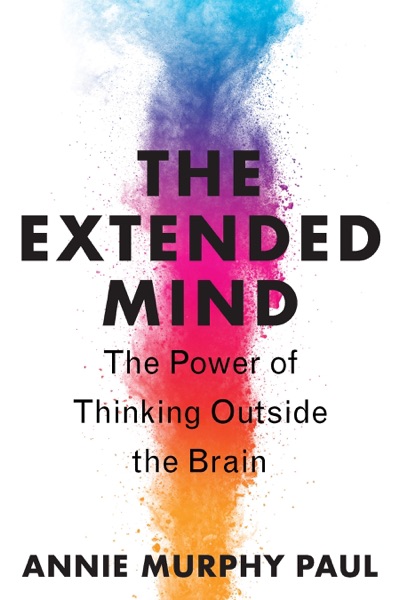
The Extended Mind is Annie Murphy Paul's argument that the brain is not the only seat of cognition. Drawing on research across cognitive science, neuroscience, and psychology, Paul makes the case that humans routinely outsource and extend their thinking through the body, through physical spaces, and through other people — and that understanding this can dramatically change how we learn, work, and create.
Paul organizes the book around three resources that people can recruit for thinking: interoception (sensing the body's internal states), the physical environment (spaces, objects, gestures), and social contexts (other minds). Each section is built from research that tends to be scattered across academic disciplines and rarely synthesized for a general reader. The body section covers findings on how physical movement, embodied gestures, and gut feelings influence cognition in ways that are invisible when you treat the brain as the only input. People who gesture while learning retain more; people who pay attention to their physical sensations make better predictions; physical arrangements of information on a page or a table affect the quality of the reasoning done with them.
What it gets right
- 1.
Cognition extends beyond the brain. The body, the physical environment, and other people are not just supports for thinking — they are part of the cognitive process itself.
- 2.
Interoception — sensing internal body states — improves decision-making. Attending to physical signals like heart rate, gut feelings, and physical tension gives access to information that the conscious brain processes more slowly.
- 3.
Gesture enhances thinking and learning. People who gesture while explaining or learning retain more and understand better. Gestures are not just communication tools; they are thinking tools.
What it covers
Who wrote it
Annie Murphy Paul is an American science writer whose work covers the science of learning, intelligence, and human development. She is the author of The Cult of Personality Testing and Origins, a book about prenatal learning. Her articles have appeared in The New York Times Magazine, Scientific American, Time, and many other publications. She writes the newsletter The Science of Learning, which draws on research across cognitive science and neuroscience to examine how people learn and perform. The Extended Mind, published in 2021, draws together a decade of research into embodied and situated cognition.
