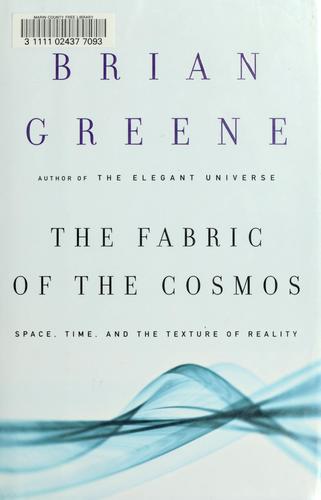
Talk to The Fabric of the Cosmos like its author wrote you back.
Get the ideas that fit your life — not generic summaries.
- Chat with the book
- Audiobook-style main ideas
- Adapts to your life and goals
- Helps you take action
The Fabric of the Cosmos, in detail
The Fabric of the Cosmos is Brian Greene's attempt to explain what physicists actually mean when they talk about space and time — not the intuitive everyday notions, but the deeply strange picture that emerges from general relativity and quantum mechanics. The ambition is larger than most popular science books: Greene isn't just explaining one theory, he's laying out the full conceptual landscape of modern physics, from Newton's absolute space to string theory and the possibility of a holographic universe.
The book opens with the nature of space itself. Is space a real physical thing that exists independently of matter, or just a convenient fiction? Newton thought it was absolute. Leibniz disagreed. Mach took a third view. Einstein transformed the question entirely, showing that space and time are woven into a single flexible fabric that warps in the presence of mass and energy. Greene explains this with unusual clarity, grounding each idea in thought experiments before the math arrives.
The quantum mechanics section covers the double-slit experiment, entanglement, and the various interpretations of what quantum theory actually means — Copenhagen, many-worlds, and others. Greene is candid that no interpretation is fully satisfying, and that physicists routinely use quantum mechanics without agreeing on what it is. The section on entropy and the arrow of time is one of the book's strongest: Greene traces the deep puzzle of why time flows only forward to the low-entropy initial conditions of the Big Bang, not to any fundamental asymmetry in physical law.
The later chapters cover string theory and M-theory, braneworld cosmology, and the holographic principle — the idea that the information content of a region of space may be fully encoded on its boundary. Greene is a string theorist himself, and his enthusiasm shows, though he's careful to distinguish what has experimental support from what remains speculative. The Fabric of the Cosmos rewards patient readers with a rare sense of having understood why physicists believe what they believe, not just what they believe.
The big ideas
- 1.
Space and time are not a fixed backdrop for events but a dynamic fabric that curves in response to mass and energy — and that curvature is what we call gravity.
- 2.
The arrow of time — the fact that past and future feel different — is not built into physical law. It comes from the Big Bang's extraordinarily low-entropy initial condition.
- 3.
Quantum entanglement allows distant particles to be correlated in ways that violate classical intuitions about locality, though it cannot be used to transmit information faster than light.
