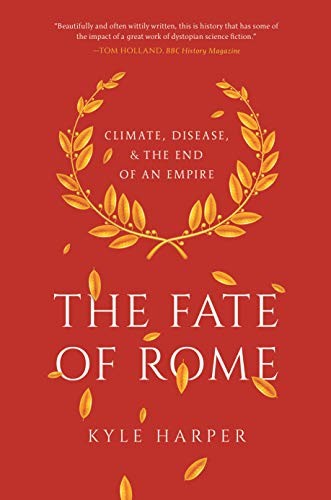
Talk to The Fate of Rome: Climate, Disease, and the End of an Empire like its author wrote you back.
Get the ideas that fit your life — not generic summaries.
- Chat with the book
- Audiobook-style main ideas
- Adapts to your life and goals
- Helps you take action
What it argues
The Fate of Rome makes a revisionist argument about one of history's most debated questions. Kyle Harper, a classicist and historian at the University of Oklahoma, draws on paleoclimatology, ancient DNA analysis, and documentary sources to argue that environmental forces — climate change and pandemic disease — were decisive causes of Rome's collapse, not merely background noise to the political and military story that older historians emphasized.
The book opens by documenting the Roman Climate Optimum, a period of unusual warmth and stability that lasted from roughly the second century BCE to the mid-second century CE. This climatic window, Harper argues, was no coincidence for Roman expansion: it supported agricultural productivity, population growth, and the dense connectivity of the empire's trade networks. Rome did not just happen to flourish during this period; it could not have reached the same scale under more adverse conditions.
What it gets right
- 1.
The Roman Climate Optimum — a period of unusual warmth and stability lasting several centuries — was a precondition for Rome's expansion, not merely a backdrop to it. Climate made Roman civilization possible at the scale it achieved.
- 2.
The Antonine Plague (165–180 CE) and the Plague of Cyprian (249–262 CE) killed a significant fraction of the empire's population and had cascading effects on military manpower, fiscal capacity, and political stability.
- 3.
Ancient DNA analysis has allowed historians to identify specific pathogens behind ancient plagues with a precision impossible in Gibbon's era. The methodological advance reopens debates that seemed settled.
What it covers
Who wrote it
Kyle Harper is a historian and professor at the University of Oklahoma whose work focuses on the Roman world, early Christianity, and environmental history. Before The Fate of Rome, he published Slavery in the Late Roman World and From Shame to Sin. His scholarship draws on documentary history, archaeology, and natural science, reflecting a broader move in classical studies toward interdisciplinary methods. The Fate of Rome won wide attention from both academic historians and general readers and has become a reference point for the emerging field of environmental history of the ancient world.
