The Fate of Rome: Climate, Disease, and the End of an Empire by Kyle Harper is a 2017 history book about climate and civilization, pandemic disease, roman decline. The Roman Climate Optimum — a period of unusual warmth and stability lasting several centuries — was a precondition for Rome's expansion, not merely a backdrop to it. Climate made Roman civilization possible at the scale it achieved.
Summary
The Fate of Rome makes a revisionist argument about one of history's most debated questions. Kyle Harper, a classicist and historian at the University of Oklahoma, draws on paleoclimatology, ancient DNA analysis, and documentary sources to argue that environmental forces — climate change and pandemic disease — were decisive causes of Rome's collapse, not merely background noise to the political and military story that older historians emphasized.
The book opens by documenting the Roman Climate Optimum, a period of unusual warmth and stability that lasted from roughly the second century BCE to the mid-second century CE. This climatic window, Harper argues, was no coincidence for Roman expansion: it supported agricultural productivity, population growth, and the dense connectivity of the empire's trade networks. Rome did not just happen to flourish during this period; it could not have reached the same scale under more adverse conditions.
The turn comes in the third century. A series of pandemics — the Antonine Plague under Marcus Aurelius, then the Plague of Cyprian beginning in 249 CE — devastated the empire's population and military. Ancient DNA evidence, largely unavailable before the last decade, has allowed Harper to identify some of these pathogens with new precision. The climatic cooling that began in the third century compounded the damage by reducing agricultural yields and straining the fiscal system that funded the legions. Gibbon's barbarians were real, but they were pushing against an empire already weakened by forces it had no framework to understand.
The argument is not that politics and culture were irrelevant — Harper is too careful a historian for that — but that environmental and epidemiological factors have been systematically underweighted because they left fewer legible traces in the documentary record. The Fate of Rome is a case study in how new scientific tools can reopen apparently settled historical debates. It also carries an implicit contemporary resonance: an empire at the height of its power, undone by a warming climate and a sequence of unfamiliar pathogens, is a story with obvious present-tense implications that Harper addresses directly in his conclusion.
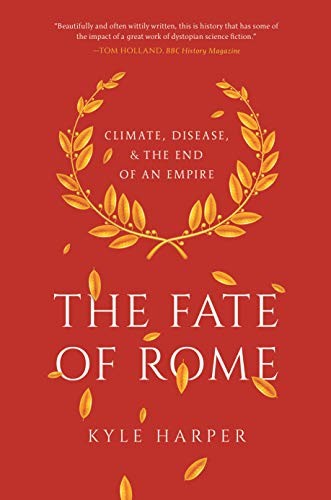
Talk to The Fate of Rome: Climate, Disease, and the End of an Empire like its author wrote you back.
Get the ideas that fit your life — not generic summaries.
- Chat with the book
- Audiobook-style main ideas
- Adapts to your life and goals
- Helps you take action
Key takeaways
- 1.
The Roman Climate Optimum — a period of unusual warmth and stability lasting several centuries — was a precondition for Rome's expansion, not merely a backdrop to it. Climate made Roman civilization possible at the scale it achieved.
- 2.
The Antonine Plague (165–180 CE) and the Plague of Cyprian (249–262 CE) killed a significant fraction of the empire's population and had cascading effects on military manpower, fiscal capacity, and political stability.
- 3.
Ancient DNA analysis has allowed historians to identify specific pathogens behind ancient plagues with a precision impossible in Gibbon's era. The methodological advance reopens debates that seemed settled.
- 4.
Climatic deterioration in the third century — the beginning of the Late Antique Little Ice Age — reduced agricultural productivity and strained the fiscal system that funded Roman armies, compounding the effects of pandemic mortality.
- 5.
The barbarian invasions that feature prominently in older accounts were real, but Harper argues they succeeded because the empire was already severely weakened by environmental and epidemiological shocks.
- 6.
Rome's connected trade networks, which were a source of strength during the Climate Optimum, became vectors for pathogen spread during the pandemic periods. Integration and vulnerability are two sides of the same coin.
- 7.
Environmental history requires reading sources against the grain. Documentary records were kept by literate elites who had little framework for understanding climate or epidemiology; paleoclimatic proxies and ancient DNA fill the gaps.
- 8.
The implicit contemporary argument: a highly integrated civilization, at the height of its economic power, proved vulnerable to climate shifts and novel pandemics it did not anticipate. The analogy is uncomfortable and Harper does not shy away from it.
Discussion questions
Use these on your own, with a book club, or as chat starters in Superbook. Book club version, ready to copy or print →
- 1.
Harper argues that climate and disease have been underweighted in accounts of Rome's fall because they left fewer legible documentary traces. Does absence of evidence imply absence of importance, or does this suggest a broader problem with how history is written?
- 2.
The Roman Climate Optimum supported expansion; climatic deterioration helped end the empire. Does that deterministic logic leave room for agency — could different decisions have changed the outcome?
- 3.
Ancient DNA and paleoclimatology are new tools applied to old questions. What other historical questions do you think might be rewritten by scientific advances in the next generation?
- 4.
Harper suggests Rome's connected trade networks became vectors for pandemic spread. What does that observation suggest about the relationship between globalization and vulnerability today?
- 5.
The Antonine Plague coincided with the reign of Marcus Aurelius, whom historians often praise as Rome's best emperor. How does Harper's environmental lens change or complicate the traditional great-man narrative?
- 6.
The book implicitly compares Rome's fate to contemporary climate and pandemic risks. Is that comparison illuminating, or does it impose present concerns on a genuinely different historical situation?
- 7.
Harper emphasizes that Romans had no conceptual framework to understand climate change or germ theory. How much does that ignorance explain their response, and how much does it excuse it?
- 8.
Gibbon blamed Christianity and political failure; Harper blames climate and disease. These are not mutually exclusive. How would you integrate all these factors into a single account?
- 9.
How does the fate of Rome's western and eastern halves look different through Harper's environmental lens versus Gibbon's political lens?
- 10.
The book is written for both academic and general audiences. Does that dual audience create tensions in how the argument is presented?
- 11.
What does 'resilience' mean for a complex civilization, based on what you learn from Rome's experience? What made Rome more or less able to absorb shocks?
- 12.
If you were advising a Roman emperor in 200 CE with knowledge of what was coming, what could realistically be done to prepare?
Themes
Frequently asked questions
-
What is The Fate of Rome's main argument?
That climate change and pandemic disease — not primarily military failure, political dysfunction, or Christianity — were the decisive causes of Rome's third-century crisis and eventual western collapse. Harper uses paleoclimatology and ancient DNA to make the case that environmental forces have been systematically underweighted in older accounts.
-
Is The Fate of Rome accessible to non-specialist readers?
Yes, though it's more demanding than popular history. Harper explains his scientific sources clearly, but the book assumes readers can follow a sustained analytical argument. Readers with some background in Roman history will get the most from it, but it's designed for a general educated audience.
-
How does The Fate of Rome relate to Gibbon's Decline and Fall?
It's partly a revision of Gibbon, adding environmental and epidemiological causes to his political and religious ones. Harper acknowledges Gibbon's greatness as a historian while arguing that the scientific tools available in the eighteenth century made certain causes invisible. The two books are complementary rather than competing.
-
Is the comparison to modern climate change explicit?
Yes. Harper addresses it directly in his conclusion, drawing parallels between a civilization undone by climate disruption and pandemic disease and our contemporary situation. He is measured rather than polemical about it, but the contemporary resonance is deliberate.
-
Who should read The Fate of Rome?
Anyone interested in Roman history, environmental history, or the history of epidemics. It's particularly useful for readers who want to understand how natural science is changing historical scholarship, or who want to think through the historical precedents for climate and pandemic risk.
Similar books
Sapiens: A Brief History of Humankind
Yuval Noah Harari
Guns, Germs, and Steel
Jared Diamond

The Decline and Fall of the Roman Empire
Edward Gibbon
Rubicon: The Last Years of the Roman Republic
Tom Holland
