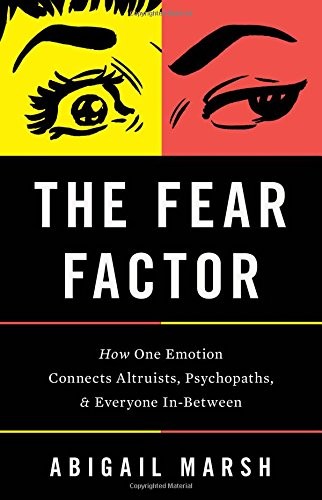
Talk to The Fear Factor: How One Emotion Connects Altruists, Psychopaths, and Everyone In-Between like its author wrote you back.
Get the ideas that fit your life — not generic summaries.
- Chat with the book
- Audiobook-style main ideas
- Adapts to your life and goals
- Helps you take action
What it argues
Abigail Marsh is a Georgetown neuroscientist who studies why some people are extraordinarily altruistic and others are not. The Fear Factor begins with a puzzle: extraordinary altruists — people who donate a kidney to a stranger — score differently on psychological tests than ordinary people, and differently again from psychopaths. The common thread, Marsh argues, is fear recognition. Extraordinary altruists are unusually sensitive to others' fear. Psychopaths are unusually insensitive to it. The amygdala, a region associated with threat detection and fear processing, turns out to be the biological hinge on which much of human morality swings.
The book weaves together her own lab research with a broader account of how fear functions in social species. Fear is usually discussed as self-regarding — you feel afraid, you respond. But Marsh's research highlights the social function of fear displays. When someone looks afraid, that signal is read by other people's amygdalae, triggering empathic concern and protective behavior. This mechanism is the evolutionary basis for altruism in social animals, including humans. When the mechanism is underactive, as in psychopathy, fear signals from others don't register, and the social inhibitions that prevent harm to others don't fire.
What it gets right
- 1.
Fear recognition is a central mechanism of human altruism. People who are more sensitive to others' fear expressions show greater empathic concern and willingness to help at personal cost.
- 2.
Psychopathy is characterized in part by reduced amygdala response to fear expressions in others. This is a measurable neurological difference, not merely a behavioral category.
- 3.
Extraordinary altruists — people who donate organs to strangers — have larger, more reactive amygdalae than average and show heightened sensitivity to frightened faces, the mirror image of the psychopathic pattern.
What it covers
Who wrote it
Abigail Marsh is a professor of psychology and neuroscience at Georgetown University, where she directs the Laboratory on Social and Affective Neuroscience. Her research focuses on altruism, psychopathy, and the neural mechanisms of empathy and fear. She has received funding from the National Institutes of Health and has published widely in journals including the Proceedings of the National Academy of Sciences. The Fear Factor is her first book for a general audience and draws directly on her lab's published research on extraordinary altruists and individuals with psychopathy.
