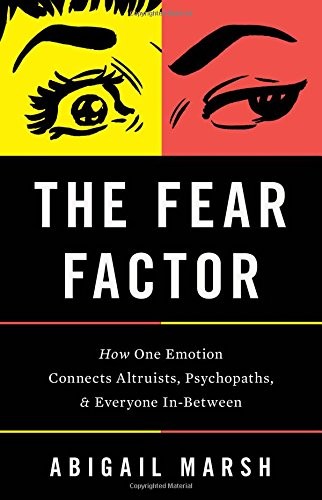
The Fear Factor: How One Emotion Connects Altruists, Psychopaths, and Everyone In-Between by Abigail Marsh is a 2017 psychology book about fear, altruism, psychopathy. Fear recognition is a central mechanism of human altruism. People who are more sensitive to others' fear expressions show greater empathic concern and willingness to help at personal cost.
Summary
Abigail Marsh is a Georgetown neuroscientist who studies why some people are extraordinarily altruistic and others are not. The Fear Factor begins with a puzzle: extraordinary altruists — people who donate a kidney to a stranger — score differently on psychological tests than ordinary people, and differently again from psychopaths. The common thread, Marsh argues, is fear recognition. Extraordinary altruists are unusually sensitive to others' fear. Psychopaths are unusually insensitive to it. The amygdala, a region associated with threat detection and fear processing, turns out to be the biological hinge on which much of human morality swings.
The book weaves together her own lab research with a broader account of how fear functions in social species. Fear is usually discussed as self-regarding — you feel afraid, you respond. But Marsh's research highlights the social function of fear displays. When someone looks afraid, that signal is read by other people's amygdalae, triggering empathic concern and protective behavior. This mechanism is the evolutionary basis for altruism in social animals, including humans. When the mechanism is underactive, as in psychopathy, fear signals from others don't register, and the social inhibitions that prevent harm to others don't fire.
Marsh is careful to note that psychopathy is not evil. It is a developmental difference with roots in genetics and early environment that produces a specific set of cognitive and emotional processing differences. The absence of fear responsiveness is not the only relevant factor, but it is a more reliable marker than many other commonly cited characteristics.
The book's most thought-provoking section involves her own extraordinary altruists — real people who donated kidneys to strangers with no expectation of reward. They are not saints; they are people whose threat-detection systems are calibrated in a particular way, and who interpret others' distress as more salient and action-requiring than most people do. This is both a fascinating scientific finding and an implicit challenge to the usual ways we think about moral behavior as the product of character or will.
Talk to The Fear Factor: How One Emotion Connects Altruists, Psychopaths, and Everyone In-Between like its author wrote you back.
Get the ideas that fit your life — not generic summaries.
- Chat with the book
- Audiobook-style main ideas
- Adapts to your life and goals
- Helps you take action
Key takeaways
- 1.
Fear recognition is a central mechanism of human altruism. People who are more sensitive to others' fear expressions show greater empathic concern and willingness to help at personal cost.
- 2.
Psychopathy is characterized in part by reduced amygdala response to fear expressions in others. This is a measurable neurological difference, not merely a behavioral category.
- 3.
Extraordinary altruists — people who donate organs to strangers — have larger, more reactive amygdalae than average and show heightened sensitivity to frightened faces, the mirror image of the psychopathic pattern.
- 4.
Fear is fundamentally a social signal. When you display fear, you are communicating vulnerability to others, and their nervous systems are wired to detect and respond to that signal.
- 5.
The same neural mechanism — amygdala responsivity to threat displays — sits beneath both extreme helping and extreme harm, depending on whether it is overactive or underactive.
- 6.
Psychopathy is not synonymous with violence. The emotional processing differences it involves lead to exploitation and callousness across many contexts, most of which never involve physical harm.
- 7.
Altruism is not simply a cultural or rational choice. Much of what drives helping behavior is automatic, affective, and rooted in the same threat-detection systems that govern fear responses.
- 8.
Early adversity can alter amygdala development and therefore alter the calibration of fear responsivity — which may explain why some environments produce people who are less responsive to others' distress.
Discussion questions
Use these on your own, with a book club, or as chat starters in Superbook. Book club version, ready to copy or print →
- 1.
Marsh argues that extraordinary altruism is partly a function of neurological calibration rather than exceptional character. Does that reduce your admiration for unusually altruistic people, or change it in a different direction?
- 2.
The book suggests that people who show low empathy for others' fear are not choosing to be indifferent — the signal simply doesn't register the same way. How should that understanding change how we respond to people who seem callous?
- 3.
If altruism is rooted in automatic fear-recognition systems, what does that imply about how we try to encourage charitable behavior through campaigns that emphasize facts and statistics rather than emotional appeals?
- 4.
Marsh distinguishes between empathic concern — feeling motivated to help — and personal distress — feeling overwhelmed by others' suffering. Have you experienced both? Which is more characteristic of how you typically respond to others' fear or pain?
- 5.
The amygdala's role in processing both self-directed fear and socially directed fear signals suggests these systems are deeply intertwined. Do people who are personally fearless seem less responsive to others' fear in your experience?
- 6.
Marsh's extraordinary altruists don't describe their kidney donations as heroic — they genuinely didn't find it that difficult. What does that suggest about how we identify and cultivate altruism in society?
- 7.
The book implies that psychopathy is at one end of a normally distributed trait, with extraordinary altruism at the other. Where do most people fall, and is the distribution actually symmetrical?
- 8.
Marsh's research focuses heavily on the amygdala, but she acknowledges it is one node in a complex system. How much does reducing complex social behavior to single brain regions help versus obscure understanding?
- 9.
What does the neuroscience of fear recognition imply about moral education — is teaching children to recognize and respond to others' fear more important than teaching them rules about right and wrong?
- 10.
Marsh became a researcher partly through a near-death experience involving a stranger who helped her without hesitation. How much do you think direct exposure to extreme altruism shifts people's behavior toward altruism themselves?
- 11.
If you could identify the amygdala responsivity level of job candidates for roles like law enforcement, medicine, or finance, would you want to? What would be the problems with that?
- 12.
The book ends with an implicit argument for human goodness. Does the evidence Marsh presents feel reassuring, or does the contingency of goodness on neurological calibration seem fragile?
Themes
Frequently asked questions
-
What is The Fear Factor about?
It is about the role of fear recognition in human altruism and psychopathy. Marsh argues that the ability to read and respond to others' fear expressions is a key neurological mechanism underlying prosocial behavior, and that deficits in this system explain much of what characterizes psychopathic indifference.
-
Is The Fear Factor worth reading?
Yes, particularly for readers interested in the neuroscience of morality. Marsh writes with authority about her own research without making it feel inaccessible. The book is more evidence-grounded than many popular psychology books and makes a genuinely novel argument.
-
How does The Fear Factor define psychopathy?
As a developmental difference characterized partly by reduced amygdala response to fear signals from others. Marsh is careful to distinguish this from violence or evil — most people with psychopathic traits never commit crimes. The emotional processing difference is the defining feature, not any particular behavior.
-
Who should read The Fear Factor?
Anyone interested in why people help or harm each other at a biological level. Also useful for people in clinical psychology, criminology, or policy who want a more nuanced model of psychopathy than the cultural caricature.
-
Is altruism just neurology according to this book?
Not entirely, but more than most people assume. Marsh argues that neurological calibration — particularly amygdala reactivity — creates the conditions for altruistic behavior, but environment, culture, and deliberate practice also matter. The book argues against pure voluntarism in moral behavior without reducing it to pure biology.
Similar books
Behave: The Biology of Humans at Our Best and Worst
Robert M. Sapolsky
The Righteous Mind: Why Good People Are Divided by Politics and Religion
Jonathan Haidt
Emotional Intelligence
Daniel Goleman
Thinking, Fast and Slow
Daniel Kahneman
