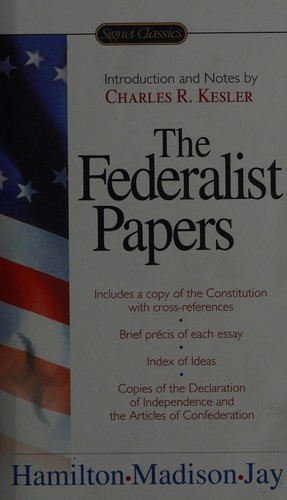
Talk to The Federalist Papers like its author wrote you back.
Get the ideas that fit your life — not generic summaries.
- Chat with the book
- Audiobook-style main ideas
- Adapts to your life and goals
- Helps you take action
What it argues
The Federalist Papers are a collection of eighty-five essays written by Alexander Hamilton, James Madison, and John Jay between October 1787 and May 1788, under the collective pseudonym Publius. Their immediate purpose was to persuade the citizens of New York to ratify the newly drafted Constitution. Their enduring status as foundational documents of American constitutional thought rests on the sophistication of the political theory the essays articulate — a theory of republican government designed to function in a large, faction-ridden, commercially oriented society.
The central problem the authors address is how to build a government strong enough to be effective while constrained enough to remain free. The Articles of Confederation had produced a government too weak to tax, regulate commerce, or enforce its own decisions. The proposed Constitution would remedy this, but opponents feared it would create a central power capable of tyranny. The Federalist essays work systematically through every major feature of the proposed government — the executive, the legislature, the judiciary, the relationship between federal and state authority — arguing that each design choice reflects a realistic understanding of human nature and faction.
What it gets right
- 1.
A large republic is more stable than a small one because its diversity of factions prevents any single faction from achieving the majority needed to oppress others — Madison's argument in Federalist 10.
- 2.
Separation of powers works not through formal prohibition but through structural incentives: each branch must have the means and the motive to resist encroachments by the others.
- 3.
Ambition must be made to counteract ambition; constitutional design cannot rely on the virtue of officeholders but must build in structural pressures that align interest with duty.
What it covers
Who wrote it
The Federalist Papers were written by Alexander Hamilton, James Madison, and John Jay, all using the pseudonym Publius. Hamilton (1755–1804) was the first Secretary of the Treasury and the dominant intellectual force behind the collection, writing roughly fifty-one of the eighty-five essays. Madison (1751–1836) became the fourth President of the United States and is considered the primary architect of the Constitution itself. John Jay (1745–1829) contributed five essays and later became the first Chief Justice of the United States Supreme Court.
