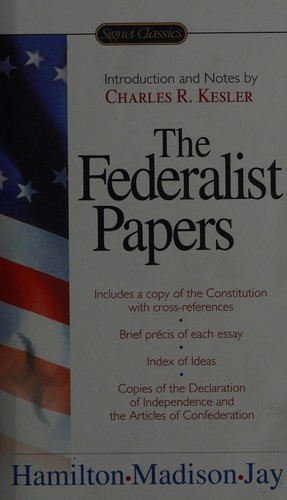
The Federalist Papers by Alexander Hamilton, James Madison, and John Jay is a 1788 history book about constitutional design, federalism, separation of powers. A large republic is more stable than a small one because its diversity of factions prevents any single faction from achieving the majority needed to oppress others — Madison's argument in Federalist 10.
Summary
The Federalist Papers are a collection of eighty-five essays written by Alexander Hamilton, James Madison, and John Jay between October 1787 and May 1788, under the collective pseudonym Publius. Their immediate purpose was to persuade the citizens of New York to ratify the newly drafted Constitution. Their enduring status as foundational documents of American constitutional thought rests on the sophistication of the political theory the essays articulate — a theory of republican government designed to function in a large, faction-ridden, commercially oriented society.
The central problem the authors address is how to build a government strong enough to be effective while constrained enough to remain free. The Articles of Confederation had produced a government too weak to tax, regulate commerce, or enforce its own decisions. The proposed Constitution would remedy this, but opponents feared it would create a central power capable of tyranny. The Federalist essays work systematically through every major feature of the proposed government — the executive, the legislature, the judiciary, the relationship between federal and state authority — arguing that each design choice reflects a realistic understanding of human nature and faction.
Madison's Federalist 10 is the essay most frequently cited in constitutional scholarship. He argues that the primary danger to republican government is not external enemies but internal factions — groups whose interest or passion overrides the common good. Small republics are destroyed by factions because majorities form easily and can tyrannize minorities. A large republic, by contrast, contains so many diverse factions that no single one can dominate; the size of the republic is a structural check on majority tyranny. This counterintuitive argument — that bigness is a republican virtue — reversed the received wisdom of ancient political theory.
Federalist 51, also attributed to Madison, gives the theory of separation of powers its classic formulation: ambition must be made to counteract ambition, and the constitutional structure must supply the incentives that make each branch an effective check on the others. Hamilton's essays defend the executive (Federalist 70) and the judiciary (Federalist 78), including the argument for judicial review that would become the basis for Marbury v. Madison. The papers are both a political campaign document and a work of applied political philosophy, and they reward reading as both.
Talk to The Federalist Papers like its author wrote you back.
Get the ideas that fit your life — not generic summaries.
- Chat with the book
- Audiobook-style main ideas
- Adapts to your life and goals
- Helps you take action
Key takeaways
- 1.
A large republic is more stable than a small one because its diversity of factions prevents any single faction from achieving the majority needed to oppress others — Madison's argument in Federalist 10.
- 2.
Separation of powers works not through formal prohibition but through structural incentives: each branch must have the means and the motive to resist encroachments by the others.
- 3.
Ambition must be made to counteract ambition; constitutional design cannot rely on the virtue of officeholders but must build in structural pressures that align interest with duty.
- 4.
An independent judiciary is necessary to maintain constitutional limits on legislative power; Federalist 78 is the founding text for the American doctrine of judicial review.
- 5.
The executive must be energetic and unified to be effective; a single president with substantial powers is safer than a weak executive or a plural one because accountability requires a single responsible actor.
- 6.
Federalism — the division of authority between national and state governments — provides an additional check on tyranny because citizens can appeal to one level against the other.
- 7.
Republican government requires informed citizens; the Federalist essays are themselves an argument that serious political deliberation must be conducted publicly and transparently.
- 8.
Human nature in the Federalist is realistic: men are not angels, factions are inevitable, and institutions must be designed for the people they will actually govern, not for idealized citizens.
Discussion questions
Use these on your own, with a book club, or as chat starters in Superbook. Book club version, ready to copy or print →
- 1.
Madison argues in Federalist 10 that a large republic is safer from faction than a small one. How does that argument look in an era of nationalized media and party polarization?
- 2.
The system of separation of powers assumes that each branch will jealously defend its prerogatives. Has that assumption held? Which branches have historically been most willing to cede power?
- 3.
Hamilton defends the electoral college as a way to produce deliberate, informed presidential selection. Does that rationale apply today, and does the institution still perform the function he described?
- 4.
Federalist 51 says the structure of government must supply the defect of better motives. What does that imply for institutional design in contexts beyond constitutional government — corporations, universities, nonprofits?
- 5.
The Federalist was written to persuade, not to provide a neutral account. Which arguments do you find genuinely persuasive and which feel like advocacy?
- 6.
Hamilton's argument for a single, energetic executive in Federalist 70 assumes that accountability requires a single responsible actor. How has the growth of executive agencies affected that logic?
- 7.
Federalist 78 argues that an independent judiciary is the least dangerous branch because it has neither force nor will, only judgment. Does that description fit the contemporary Supreme Court?
- 8.
Madison's theory of faction assumes that diverse economic and social interests will produce balanced competition. What happens when one faction becomes so dominant that the pluralism he relied on breaks down?
- 9.
The authors wrote under pseudonyms and debated attribution for years. Does knowing the individual authorship change how you read specific arguments?
- 10.
The Federalist is routinely cited by all sides in constitutional debates as authority for conflicting positions. What does that suggest about its relationship to the Constitution it was written to defend?
- 11.
Which of the institutional design choices defended in the Federalist Papers looks most prescient from a 2026 vantage point, and which looks most naive?
- 12.
How does the Federalist Papers' theory of republican government compare to Tocqueville's observations about how that government actually functioned in practice?
Themes
Frequently asked questions
-
What are The Federalist Papers?
Eighty-five essays written in 1787–88 by Hamilton, Madison, and Jay to persuade New York to ratify the U.S. Constitution. They are also the most systematic exposition of the political philosophy behind the Constitution's design and remain the standard reference for American constitutional interpretation.
-
Do I need to read all 85 Federalist Papers?
Most readers focus on the most influential essays: Federalist 10 (factions and large republics), 51 (separation of powers), 70 (the executive), and 78 (the judiciary). These four cover the core political theory. The full collection rewards reading for those interested in constitutional law or early American political thought.
-
Is The Federalist Papers worth reading today?
Yes, both as a historical document and as a work of applied political theory. The arguments about faction, institutional design, and the relationship between human nature and constitutional structure remain relevant to contemporary debates about democratic institutions.
-
Who wrote which Federalist Papers?
Hamilton wrote most of them — roughly 51 essays. Madison wrote about 29, including Federalist 10 and 51. Jay wrote 5. The attribution of several essays was disputed during the authors' lifetimes, and scholarly consensus on a few remains unsettled.
-
How long does it take to read The Federalist Papers?
The full collection is roughly 175,000 words — about twelve hours at average reading pace. Most readers read selectively, focusing on the key essays, which can be covered in two to three hours.