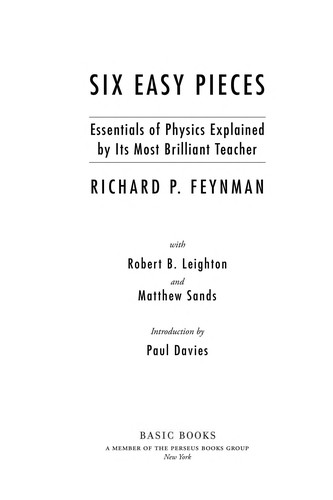
Talk to Six Easy Pieces like its author wrote you back.
Get the ideas that fit your life — not generic summaries.
- Chat with the book
- Audiobook-style main ideas
- Adapts to your life and goals
- Helps you take action
What it argues
Six Easy Pieces is a selection of six lectures from Richard Feynman's legendary Caltech introductory physics course, delivered in 1961–62 and published in full as The Feynman Lectures on Physics. The six chapters extracted here cover what Feynman considered the most accessible topics from that course: atoms in motion, basic physics, the relationship between physics and other sciences, conservation of energy, the theory of gravitation, and quantum behavior. The selection was made after Feynman's death as an entry point to his larger and more technical Lectures.
Feynman begins with atoms — the idea that all matter is made of small particles in constant motion, whose interactions under different conditions produce the diversity of physical phenomena — and treats it as one of the most important ideas in all of science. If forced to choose one sentence to pass on to future generations after some catastrophe destroyed scientific knowledge, Feynman says, he would choose the atomic hypothesis. The opening lecture unpacks why that sentence contains so much: temperature as atomic kinetic energy, pressure as atomic collision, phase transitions as changes in inter-atomic forces.
What it gets right
- 1.
The atomic hypothesis — that all matter consists of small particles in constant motion — is arguably the single most powerful idea in science, because it explains chemistry, heat, pressure, and phase change from one framework.
- 2.
Physics is the most fundamental science, but its relationship to chemistry, biology, and psychology is one of reduction, not replacement: each field has concepts and regularities that cannot be conveniently derived from scratch.
- 3.
Conservation laws are among the deepest truths in physics: energy, momentum, and angular momentum are conserved in all physical processes. Conservation principles often reveal deep symmetries in nature.
What it covers
Who wrote it
Richard P. Feynman (1918–1988) was an American theoretical physicist who shared the 1965 Nobel Prize in Physics for his work on quantum electrodynamics. He worked on the Manhattan Project at Los Alamos and spent the majority of his academic career at Caltech. His introductory physics lectures at Caltech from 1961–63, compiled as The Feynman Lectures on Physics, remain among the most widely used physics texts in the world. He served on the Rogers Commission investigating the Challenger disaster. His memoirs, particularly Surely You're Joking, Mr. Feynman!, made him a figure of popular culture as well as scientific eminence.
