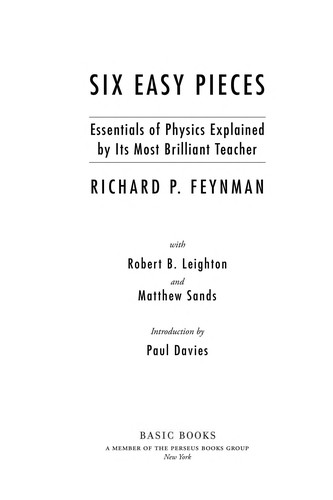
Six Easy Pieces by Richard P. Feynman is a 1994 science book about physics, atoms, quantum mechanics. The atomic hypothesis — that all matter consists of small particles in constant motion — is arguably the single most powerful idea in science, because it explains chemistry, heat, pressure, and phase change from one framework.
Summary
Six Easy Pieces is a selection of six lectures from Richard Feynman's legendary Caltech introductory physics course, delivered in 1961–62 and published in full as The Feynman Lectures on Physics. The six chapters extracted here cover what Feynman considered the most accessible topics from that course: atoms in motion, basic physics, the relationship between physics and other sciences, conservation of energy, the theory of gravitation, and quantum behavior. The selection was made after Feynman's death as an entry point to his larger and more technical Lectures.
Feynman begins with atoms — the idea that all matter is made of small particles in constant motion, whose interactions under different conditions produce the diversity of physical phenomena — and treats it as one of the most important ideas in all of science. If forced to choose one sentence to pass on to future generations after some catastrophe destroyed scientific knowledge, Feynman says, he would choose the atomic hypothesis. The opening lecture unpacks why that sentence contains so much: temperature as atomic kinetic energy, pressure as atomic collision, phase transitions as changes in inter-atomic forces.
The chapter on quantum behavior introduces the double-slit experiment — the canonical demonstration that particles like electrons have both wave and particle properties and that quantum mechanics cannot be reconciled with classical intuitions — and states flatly that nobody understands quantum mechanics in the sense of finding it intuitive. This honesty about the limits of intuition is characteristic of Feynman's teaching style.
Throughout, Feynman demonstrates his extraordinary ability to connect formal physics to everyday phenomena. Gravitation is introduced not through equations but through the historical argument about falling bodies and planetary motion. Conservation of energy is motivated by analogy before being formalized. The lectures work because Feynman is always telling you what the physics is for, not just how to calculate with it.
Talk to Six Easy Pieces like its author wrote you back.
Get the ideas that fit your life — not generic summaries.
- Chat with the book
- Audiobook-style main ideas
- Adapts to your life and goals
- Helps you take action
Key takeaways
- 1.
The atomic hypothesis — that all matter consists of small particles in constant motion — is arguably the single most powerful idea in science, because it explains chemistry, heat, pressure, and phase change from one framework.
- 2.
Physics is the most fundamental science, but its relationship to chemistry, biology, and psychology is one of reduction, not replacement: each field has concepts and regularities that cannot be conveniently derived from scratch.
- 3.
Conservation laws are among the deepest truths in physics: energy, momentum, and angular momentum are conserved in all physical processes. Conservation principles often reveal deep symmetries in nature.
- 4.
Gravitation is the weakest of the fundamental forces but the most visible on large scales, because unlike electric charge it has no negative version — gravity cannot be cancelled out.
- 5.
Nobody understands quantum mechanics in the sense of finding it intuitively natural; the double-slit experiment demonstrates behavior that has no classical analogue and requires abandoning everyday intuitions about particles and waves.
- 6.
Science progresses by experiment: theories that make predictions inconsistent with observation must be abandoned regardless of how beautiful or well-established they are.
- 7.
The relationship between physics and mathematics is one of unexpected consonance — the mathematics developed for abstract reasons by mathematicians turns out to describe the physical world with startling precision.
- 8.
Feynman's criterion for understanding: if you can't explain something in simple terms to a freshman, you don't fully understand it yourself.
Discussion questions
Use these on your own, with a book club, or as chat starters in Superbook.
- 1.
Feynman says the atomic hypothesis is the most important scientific idea. Do you agree, or is there another idea that deserves that distinction?
- 2.
He claims nobody understands quantum mechanics. Is that honesty about the limits of human intuition liberating or disturbing?
- 3.
The book presents physics as the most fundamental science, with other sciences as applications. Does that hierarchy feel right to you? What does it leave out?
- 4.
Conservation of energy seems simple but has deep implications. Had you thought about it before as a deep principle rather than just a rule for solving problems?
- 5.
Feynman draws consistent connections between formal physics and everyday phenomena. What's an example from your life where a physics principle explains something you've observed?
- 6.
The double-slit experiment shows that observing a particle changes its behavior. What does that dependence of outcome on observation say about the nature of physical reality?
- 7.
How does Feynman's teaching style — conversational, with explicit acknowledgment of what he doesn't know — differ from how physics was taught to you?
- 8.
He argues that physicists don't know what energy really is, only how to calculate with it. Does that distinction between calculation and understanding matter?
- 9.
Feynman's criterion for understanding is the ability to explain simply. Is that always achievable, or are there genuine cases where simple explanation requires distortion?
- 10.
Which of the six lectures did you find most accessible, and which most challenging?
- 11.
Feynman opens with atoms rather than motion or force, which is the more traditional entry point for introductory physics. Why might he have made that choice?
Themes
Frequently asked questions
-
Is Six Easy Pieces actually easy?
Relative to the full Feynman Lectures, yes. For general readers with no physics background, parts are accessible and others are demanding. The opening lectures on atoms and basic physics are genuinely approachable; the quantum mechanics chapter is conceptually hard despite requiring no mathematics.
-
How does this relate to The Feynman Lectures on Physics?
The Feynman Lectures are a three-volume set covering all of introductory physics — over 1,800 pages. Six Easy Pieces extracts the six most accessible chapters. Six Not-So-Easy Pieces is a companion volume with harder material on symmetry and relativity.
-
Who is the intended audience?
Feynman wrote the original lectures for first-year Caltech undergraduates with strong mathematics and physics backgrounds. Six Easy Pieces was assembled for general readers; it works without prior physics but requires patience and willingness to think carefully.
-
What is the best Feynman book for a non-scientist?
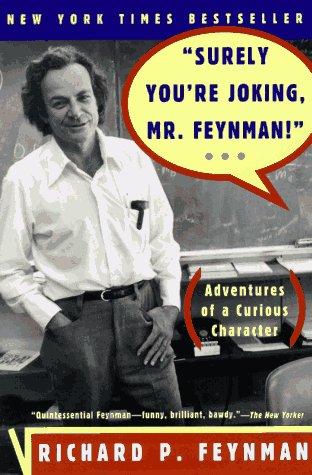
Surely You're Joking, Mr. Feynman! for his personality. Six Easy Pieces for actual physics concepts. The two together give a rounded picture of the man and his approach to science.
-
Does Feynman explain quantum mechanics simply?
He explains it honestly, which includes being honest about how strange it is. He does not simplify away the strangeness and is explicit that quantum mechanics cannot be made to feel intuitively natural. That honesty is itself clarifying — it tells you what to stop trying to do.
Similar books
Surely You're Joking, Mr. Feynman!
Richard P. Feynman
Genius: The Life and Science of Richard Feynman
James Gleick
A Brief History of Time
Stephen Hawking
Astrophysics for People in a Hurry
Neil deGrasse Tyson
