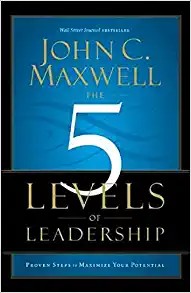
Talk to The 5 Levels of Leadership like its author wrote you back.
Get the ideas that fit your life — not generic summaries.
- Chat with the book
- Audiobook-style main ideas
- Adapts to your life and goals
- Helps you take action
The 5 Levels of Leadership, in detail
The 5 Levels of Leadership is John C. Maxwell's framework for understanding how leadership authority develops over time. The central idea is that leadership is not a position but a process, and that process moves through five distinct stages: Position (people follow because they have to), Permission (people follow because they want to), Production (people follow because of what the leader has accomplished), People Development (people follow because of what the leader has done for them personally), and Pinnacle (people follow because of who the leader is and what they represent).
Maxwell's argument is that most leaders get stuck at Level 1 or 2 and never move beyond relying on their title or their personal likeability. Real leadership leverage comes at Level 3 and above, where the leader's influence multiplies through results and through the growth of others. Level 5 is rare — Maxwell reserves it for figures like Nelson Mandela and Mother Teresa — and the book mostly concerns itself with the practical work of moving from Level 2 to Level 4.
Each level receives a full treatment: its characteristics, the upsides and downsides of staying there too long, the best behaviors for that level, and the beliefs leaders need to shed before they can move up. Maxwell also addresses the fact that a leader operates at different levels with different people simultaneously — you might be at Level 4 with your core team and Level 1 with a new hire you haven't yet built trust with.
The framework is clear and well-organized, and Maxwell's experience leading organizations over decades gives the examples credibility. The book is explicitly prescriptive and occasionally repetitive, which is a feature for some readers and a liability for others. It works best as a diagnostic tool: where are you with each person on your team, and what would it take to move up a level with them?
The big ideas
- 1.
Leadership is not a position but a process with five stages, each requiring different skills and producing different kinds of influence.
- 2.
Level 1 leadership (Position) is the floor, not the foundation. Authority derived purely from a title produces minimal discretionary effort from those below.
- 3.
Level 2 (Permission) requires building genuine relationships. People follow leaders they like and trust, which gives a leader far more influence than a title alone.
