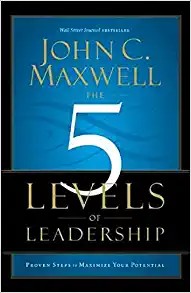
The 5 Levels of Leadership by John C. Maxwell is a 2011 business book about leadership development, influence, people development. Leadership is not a position but a process with five stages, each requiring different skills and producing different kinds of influence.
Summary
The 5 Levels of Leadership is John C. Maxwell's framework for understanding how leadership authority develops over time. The central idea is that leadership is not a position but a process, and that process moves through five distinct stages: Position (people follow because they have to), Permission (people follow because they want to), Production (people follow because of what the leader has accomplished), People Development (people follow because of what the leader has done for them personally), and Pinnacle (people follow because of who the leader is and what they represent).
Maxwell's argument is that most leaders get stuck at Level 1 or 2 and never move beyond relying on their title or their personal likeability. Real leadership leverage comes at Level 3 and above, where the leader's influence multiplies through results and through the growth of others. Level 5 is rare — Maxwell reserves it for figures like Nelson Mandela and Mother Teresa — and the book mostly concerns itself with the practical work of moving from Level 2 to Level 4.
Each level receives a full treatment: its characteristics, the upsides and downsides of staying there too long, the best behaviors for that level, and the beliefs leaders need to shed before they can move up. Maxwell also addresses the fact that a leader operates at different levels with different people simultaneously — you might be at Level 4 with your core team and Level 1 with a new hire you haven't yet built trust with.
The framework is clear and well-organized, and Maxwell's experience leading organizations over decades gives the examples credibility. The book is explicitly prescriptive and occasionally repetitive, which is a feature for some readers and a liability for others. It works best as a diagnostic tool: where are you with each person on your team, and what would it take to move up a level with them?
Talk to The 5 Levels of Leadership like its author wrote you back.
Get the ideas that fit your life — not generic summaries.
- Chat with the book
- Audiobook-style main ideas
- Adapts to your life and goals
- Helps you take action
Key takeaways
- 1.
Leadership is not a position but a process with five stages, each requiring different skills and producing different kinds of influence.
- 2.
Level 1 leadership (Position) is the floor, not the foundation. Authority derived purely from a title produces minimal discretionary effort from those below.
- 3.
Level 2 (Permission) requires building genuine relationships. People follow leaders they like and trust, which gives a leader far more influence than a title alone.
- 4.
Level 3 (Production) is where credibility accelerates. Leaders who deliver results earn the right to be heard and followed on things beyond their formal mandate.
- 5.
Level 4 (People Development) is where leadership becomes sustainable. Developing others multiplies impact and builds the next generation of leaders.
- 6.
Leaders operate at different levels with different people at the same time. The goal is to raise the average level across your whole team, not just with your favorites.
- 7.
Moving up the levels requires letting go of what worked at the lower level. Production leaders have to learn to invest in people even when tasks feel more urgent.
- 8.
Level 5 (Pinnacle) is achieved by a small number of leaders who develop other Level 4 leaders. Its effects extend far beyond the leader's tenure or organization.
Discussion questions
Use these on your own, with a book club, or as chat starters in Superbook. Book club version, ready to copy or print →
- 1.
Maxwell says most leaders stop at Level 2 and mistake likeability for genuine leadership. Where have you seen that pattern play out in organizations you've worked in?
- 2.
At which level do you currently operate with the people you lead or influence? Is that level consistent across all of them?
- 3.
The jump from Level 3 to Level 4 requires shifting from building your own results to investing in others' results. What makes that transition difficult in practice?
- 4.
Maxwell argues you can lead at different levels with different people simultaneously. What does that suggest about how you should think about your leadership strategy with each person on your team?
- 5.
Level 1 leadership produces compliance but not commitment. Where in your professional life are you currently getting compliance when you need commitment?
- 6.
The book reserves Level 5 for historical figures. Is that a useful standard or an unrealistic one that makes the framework feel inaccessible?
- 7.
Which of Maxwell's five levels feels most natural to you, and which feels most foreign? What does that tell you about your default leadership style?
- 8.
Maxwell says leaders need to give up what worked at lower levels to advance. What are you holding onto right now that might be limiting your growth?
- 9.
How does the five-level framework apply in contexts where formal authority is absent — peer relationships, volunteer roles, or cross-functional teams?
- 10.
Maxwell writes that the goal of leadership is developing other leaders, not developing followers. How does your organization currently reward or ignore that distinction?
- 11.
The framework is prescriptive and optimistic. What does it leave out about the structural or systemic barriers that prevent leaders from advancing regardless of their skills?
Themes
Frequently asked questions
-
Is The 5 Levels of Leadership worth reading?
Yes, if you want a clear, accessible framework for thinking about where you are as a leader and what growth would require. The model is genuinely useful for diagnosing relationships within a team. Readers who have already read widely on leadership will find the ideas familiar but appreciate the systematic organization.
-
How long does it take to read The 5 Levels of Leadership?
Around four to five hours. The chapters are structured consistently — each level gets the same treatment — so the book moves quickly once you understand the pattern. Some readers skim the later levels after grasping the framework in the first two.
-
What is the main idea of The 5 Levels of Leadership?
Leadership authority grows through five stages, and real influence only develops once you move beyond your title and positional power. The highest forms of leadership come from investing in the development of other leaders, not just producing results yourself.
-
Who should read The 5 Levels of Leadership?
Managers early in their leadership development, people transitioning from individual contributor roles, and leaders who feel their teams aren't fully engaged. The framework is also useful for organizations designing leadership development programs.
-
How does this book compare to Maxwell's other leadership books?
The 5 Levels is considered one of Maxwell's most structured and actionable works. The 21 Irrefutable Laws is broader and more conceptual. Developing the Leader Within You is more about personal growth. The 5 Levels stands out for its diagnostic clarity — it gives you a concrete way to assess where you are with each person you lead.