Talk to The Forever War like its author wrote you back.
Get the ideas that fit your life — not generic summaries.
- Chat with the book
- Audiobook-style main ideas
- Adapts to your life and goals
- Helps you take action
What it argues
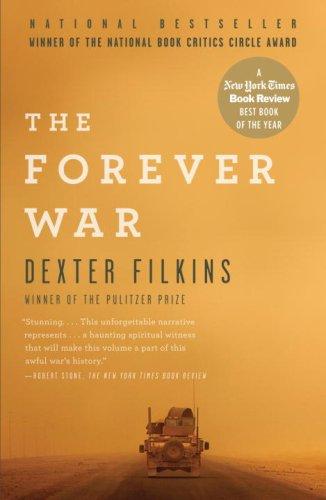
Dexter Filkins spent more than a decade covering the wars in Afghanistan and Iraq for the New York Times, and The Forever War is his attempt to render what he witnessed in a form that is closer to literature than journalism. The book won the National Book Critics Circle Award in 2008. It does not argue a thesis about American foreign policy or provide a strategic overview of either war. Instead, it accumulates scenes: a Taliban execution in a Kabul soccer stadium, a night assault on a Fallujah street, a suicide bombing at a Baghdad marketplace, a conversation with an insurgent who cannot quite explain why he is fighting.
Filkins writes in a compressed, present-tense style that strips away editorial distance. The prose rarely tells you how to feel. A scene ends and another begins, and the effect is of immersion rather than analysis. He is interested in the texture of violence — how it feels to run toward a building under fire, what the aftermath of a car bombing looks like — but also in the moments of normalcy and connection that persist alongside it: friendships with interpreters, meals with soldiers, conversations with ordinary Afghans and Iraqis trying to live their lives in circumstances of extreme danger.
What it gets right
- 1.
War resists strategic narrative. Filkins deliberately withholds policy analysis to force the reader to confront the experiential reality of combat and its aftermath without the comfort of explanation.
- 2.
The Taliban's brutality in pre-invasion Afghanistan was not ideology filtered through news reports but visible public performance — executions, amputations, and control of daily life conducted in the open.
- 3.
The battle of Fallujah in November 2004 was one of the most intense urban combat operations in American military history since Vietnam, involving house-to-house fighting against entrenched insurgents.
What it covers
Who wrote it
Dexter Filkins is a staff writer at The New Yorker and a former correspondent for the New York Times, where he covered the wars in Afghanistan and Iraq for more than a decade. He has won the George Polk Award, the Overseas Press Club Award, and the Livingston Award for international reporting. The Forever War won the National Book Critics Circle Award in 2008. He is also the author of essays and longform investigations into political violence, terrorism, and foreign policy. He teaches at Harvard's Kennedy School of Government.
