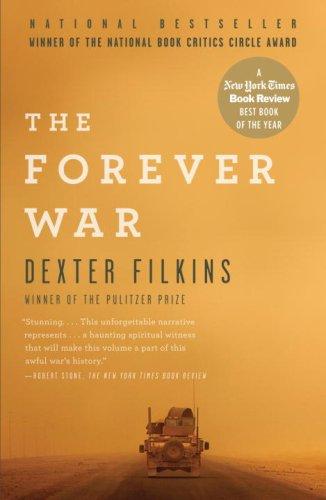
The Forever War by Dexter Filkins is a 2008 history book about war, journalism, afghanistan and iraq. War resists strategic narrative. Filkins deliberately withholds policy analysis to force the reader to confront the experiential reality of combat and its aftermath without the comfort of explanation.
Summary
Dexter Filkins spent more than a decade covering the wars in Afghanistan and Iraq for the New York Times, and The Forever War is his attempt to render what he witnessed in a form that is closer to literature than journalism. The book won the National Book Critics Circle Award in 2008. It does not argue a thesis about American foreign policy or provide a strategic overview of either war. Instead, it accumulates scenes: a Taliban execution in a Kabul soccer stadium, a night assault on a Fallujah street, a suicide bombing at a Baghdad marketplace, a conversation with an insurgent who cannot quite explain why he is fighting.
Filkins writes in a compressed, present-tense style that strips away editorial distance. The prose rarely tells you how to feel. A scene ends and another begins, and the effect is of immersion rather than analysis. He is interested in the texture of violence — how it feels to run toward a building under fire, what the aftermath of a car bombing looks like — but also in the moments of normalcy and connection that persist alongside it: friendships with interpreters, meals with soldiers, conversations with ordinary Afghans and Iraqis trying to live their lives in circumstances of extreme danger.
The book covers Filkins's time in Afghanistan before and after September 11, the fall of the Taliban, the Iraq invasion and its descent into sectarian war, and his return visits to both countries years later. He is present at some of the most significant events of the wars — the battle of Fallujah in 2004 was among the most intense urban combat Americans had experienced since Vietnam — and his account of that battle is one of the most vivid pieces of war writing in contemporary American literature.
Filkins is not a detached observer. The book is partly about what bearing witness does to the witness. He describes the psychological cost of years spent in proximity to violence, the difficulty of readjusting to civilian life, and the strange pull of the war zone for those who have spent enough time there. For anyone trying to understand what the post-9/11 wars actually felt like from the inside, The Forever War is the closest available account.
Talk to The Forever War like its author wrote you back.
Get the ideas that fit your life — not generic summaries.
- Chat with the book
- Audiobook-style main ideas
- Adapts to your life and goals
- Helps you take action
Key takeaways
- 1.
War resists strategic narrative. Filkins deliberately withholds policy analysis to force the reader to confront the experiential reality of combat and its aftermath without the comfort of explanation.
- 2.
The Taliban's brutality in pre-invasion Afghanistan was not ideology filtered through news reports but visible public performance — executions, amputations, and control of daily life conducted in the open.
- 3.
The battle of Fallujah in November 2004 was one of the most intense urban combat operations in American military history since Vietnam, involving house-to-house fighting against entrenched insurgents.
- 4.
American soldiers in Iraq were often operating in conditions of genuine ambiguity — unable to distinguish combatants from civilians, unable to understand the political dynamics of the communities they occupied.
- 5.
Interpreters and local employees working with American forces faced mortal danger both from insurgents who considered them collaborators and from the chaos of combat operations.
- 6.
The wars created a cohort of American reporters, soldiers, and aid workers who became psychologically dependent on the intensity of the war zone in ways that made reintegrating into civilian life profoundly difficult.
- 7.
Years of reporting in Afghanistan and Iraq convinced Filkins that the wars were producing effects opposite to their stated goals — that each escalation deepened the conditions that produced resistance.
- 8.
The emotional and psychological costs borne by Iraqis and Afghans — losses of family, home, security, and normal life — are largely invisible in American accounts of these wars.
Discussion questions
Use these on your own, with a book club, or as chat starters in Superbook. Book club version, ready to copy or print →
- 1.
Filkins chooses to write scenes rather than make arguments. What does that formal choice gain, and what does it sacrifice?
- 2.
The book covers Afghanistan before and after the Taliban's fall. How does the Taliban's public brutality in the 1990s compare to how you understood it before reading the book?
- 3.
Filkins describes the psychological pull of the war zone. What does it say about human psychology that people can become attached to conditions of extreme danger?
- 4.
The interpreters and local employees appear throughout the book in conditions of exceptional vulnerability. What moral obligations did that vulnerability create for the journalists and soldiers they worked with?
- 5.
The battle of Fallujah is the book's most intense section. What ethical questions does that kind of urban combat raise for the soldiers carrying it out?
- 6.
Filkins rarely editorializes about American policy. Does the accumulation of scenes carry an implicit argument, or does it genuinely leave the reader to draw their own conclusions?
- 7.
The book was published in 2008. How does it read differently now that both wars have formally ended and their long-term outcomes are clearer?
- 8.
Filkins describes the difficulty of reintegrating into civilian life after years of war reporting. What parallel experiences exist in other professions that involve sustained exposure to trauma?
- 9.
The title The Forever War suggests a cycle with no resolution. Do you think that framing was accurate, and does it remain accurate now?
- 10.
What responsibility does journalism bear for shaping public understanding of wars that most citizens will never see directly?
- 11.
Which specific scene in the book stayed with you longest, and what does that tell you about how you process information about war?
Themes
Frequently asked questions
-
Is The Forever War worth reading?
Yes, particularly for readers who want to understand what the post-9/11 wars felt like on the ground rather than from a strategic or policy altitude. Filkins is one of the finest living war correspondents, and the book reads more like literary fiction than standard journalism. It is not a comfortable read.
-
How long is The Forever War?
Around 350 pages. At average reading pace expect five to six hours. The present-tense, scene-based writing moves quickly despite the gravity of the subject matter.
-
What is the book about, exactly?
Filkins's firsthand reporting from Afghanistan in the late 1990s, the Taliban years, the invasion after 9/11, and the Iraq War from 2003 onward. It is organized as connected scenes rather than a chronological history — more memoir than journalism in form.
-
Does the book take a political position on the wars?
Not explicitly. Filkins withholds editorial judgment almost entirely. The implicit argument emerges from accumulation: scenes of American military operations generating their own opposition, civilian deaths going unacknowledged, stated goals diverging from visible outcomes. Readers will draw their own conclusions.
-
Who should read this book?
Anyone seriously trying to understand the post-9/11 wars beyond headlines and policy analysis. It is especially valuable for readers who want to understand the human experience of both sides — American soldiers and the populations they operated among — without being lectured at.
Similar books

The Looming Tower: Al-Qaeda and the Road to 9/11
Lawrence Wright
Say Nothing: A True Story of Murder and Memory in Northern Ireland
Patrick Radden Keefe
Unbroken: A World War II Story of Survival, Resilience, and Redemption
Laura Hillenbrand
Between the World and Me
Ta-Nehisi Coates
