Talk to The Four Pillars of Investing like its author wrote you back.
Get the ideas that fit your life — not generic summaries.
- Chat with the book
- Audiobook-style main ideas
- Adapts to your life and goals
- Helps you take action
The Four Pillars of Investing, in detail
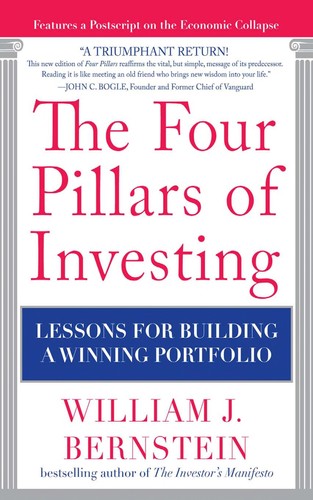
The Four Pillars of Investing is William Bernstein's rigorous guide to building and managing an investment portfolio, organized around the four things every serious investor needs to understand: investment theory, investment history, the psychology of investing, and the investment business. Bernstein is a neurologist and a self-taught investor who became a leading figure in the evidence-based investing movement, and this book is his attempt to give individual investors the intellectual foundation to manage their own money without depending on advisors who often have conflicting interests.
The first pillar — theory — covers the relationship between risk and return, mean-variance optimization, the efficient market hypothesis, and asset pricing. Bernstein presents these ideas with unusual clarity and explains why certain asset classes (small-cap stocks, value stocks) have historically provided higher returns and what economic justification exists for those premiums. He is skeptical of complexity for its own sake but rigorous about the theory that supports simple indexing.
The second pillar — history — is the book's strongest section. Bernstein traces the history of financial markets across centuries and across countries, showing that financial history is punctuated by catastrophic crashes, that past returns do not predict future returns, and that investors who have not lived through extreme market stress are almost certainly overestimating their risk tolerance. The historical perspective is sobering: markets can decline by fifty or eighty percent and take decades to recover. Designing a portfolio without accounting for that possibility is designing for conditions that have never actually described all of financial history.
The third pillar — psychology — addresses the behavioral failures that lead investors to underperform the very funds they hold, and the fourth — the investment business — provides a direct critique of the financial services industry: brokers have conflicts of interest, actively managed funds are expensive and underperform, and the complexity of financial products often serves the seller rather than the buyer. The practical prescription that emerges is simple: buy a portfolio of low-cost index funds, hold it through all market conditions, and ignore the industry's noise.
The big ideas
- 1.
Risk and return are inseparable. Asset classes that have historically provided higher long-run returns (stocks over bonds, small caps over large caps, value over growth) are riskier in ways that cannot be diversified away.
- 2.
Investment history is longer and more violent than most investors' personal experience. Markets have declined by 80-90 percent in the past and taken decades to recover. Portfolio construction must account for this.
- 3.
The efficient market hypothesis does not mean markets are always right. It means that finding consistent mispricings is very difficult, and the evidence for doing so in advance is poor.
