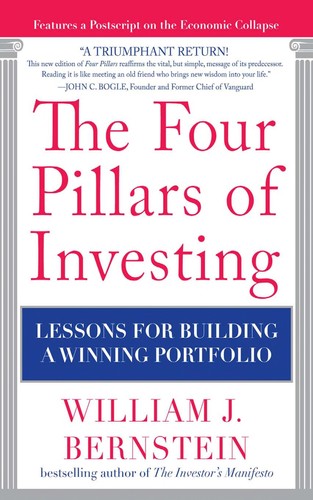
The Four Pillars of Investing by William J. Bernstein is a 2002 economics book about asset allocation, investment theory, market history. Risk and return are inseparable. Asset classes that have historically provided higher long-run returns (stocks over bonds, small caps over large caps, value over growth) are riskier in ways that cannot be diversified away.
Summary
The Four Pillars of Investing is William Bernstein's rigorous guide to building and managing an investment portfolio, organized around the four things every serious investor needs to understand: investment theory, investment history, the psychology of investing, and the investment business. Bernstein is a neurologist and a self-taught investor who became a leading figure in the evidence-based investing movement, and this book is his attempt to give individual investors the intellectual foundation to manage their own money without depending on advisors who often have conflicting interests.
The first pillar — theory — covers the relationship between risk and return, mean-variance optimization, the efficient market hypothesis, and asset pricing. Bernstein presents these ideas with unusual clarity and explains why certain asset classes (small-cap stocks, value stocks) have historically provided higher returns and what economic justification exists for those premiums. He is skeptical of complexity for its own sake but rigorous about the theory that supports simple indexing.
The second pillar — history — is the book's strongest section. Bernstein traces the history of financial markets across centuries and across countries, showing that financial history is punctuated by catastrophic crashes, that past returns do not predict future returns, and that investors who have not lived through extreme market stress are almost certainly overestimating their risk tolerance. The historical perspective is sobering: markets can decline by fifty or eighty percent and take decades to recover. Designing a portfolio without accounting for that possibility is designing for conditions that have never actually described all of financial history.
The third pillar — psychology — addresses the behavioral failures that lead investors to underperform the very funds they hold, and the fourth — the investment business — provides a direct critique of the financial services industry: brokers have conflicts of interest, actively managed funds are expensive and underperform, and the complexity of financial products often serves the seller rather than the buyer. The practical prescription that emerges is simple: buy a portfolio of low-cost index funds, hold it through all market conditions, and ignore the industry's noise.
Talk to The Four Pillars of Investing like its author wrote you back.
Get the ideas that fit your life — not generic summaries.
- Chat with the book
- Audiobook-style main ideas
- Adapts to your life and goals
- Helps you take action
Key takeaways
- 1.
Risk and return are inseparable. Asset classes that have historically provided higher long-run returns (stocks over bonds, small caps over large caps, value over growth) are riskier in ways that cannot be diversified away.
- 2.
Investment history is longer and more violent than most investors' personal experience. Markets have declined by 80-90 percent in the past and taken decades to recover. Portfolio construction must account for this.
- 3.
The efficient market hypothesis does not mean markets are always right. It means that finding consistent mispricings is very difficult, and the evidence for doing so in advance is poor.
- 4.
Behavioral errors — overconfidence, panic selling, chasing performance — are responsible for a large fraction of the gap between fund returns and investor returns.
- 5.
The financial services industry's incentives are often misaligned with investors' interests. Complexity, frequent trading, and active management primarily enrich the industry.
- 6.
Asset allocation — the mix of stocks, bonds, and other asset classes — determines most of the long-run variability in portfolio returns. Security selection matters much less.
- 7.
International diversification reduces risk without necessarily reducing expected returns, because different country markets have imperfect correlation with each other.
- 8.
The portfolio you can stick with through a market crash is better than the theoretically optimal portfolio you will abandon. Behavioral sustainability is a portfolio requirement.
Discussion questions
Use these on your own, with a book club, or as chat starters in Superbook. Book club version, ready to copy or print →
- 1.
Bernstein says most investors significantly overestimate their risk tolerance until they experience a real bear market. How did you actually behave during the most significant market decline you have personally experienced?
- 2.
The history pillar shows that markets can lose most of their value and take decades to recover. Does knowing that change your asset allocation, or do you think it won't happen in your investing lifetime?
- 3.
Bernstein is skeptical of investment advisors whose compensation depends on the products they sell. Have you ever had an advisor whose advice was clearly influenced by their compensation structure?
- 4.
The four pillars framework suggests that most investors lack at least one — either the theory, the history, the psychological self-awareness, or the understanding of how the industry works. Which pillar is weakest in your own case?
- 5.
Bernstein argues that complexity in financial products almost always benefits the seller. Can you think of a financial product you own or have been offered where the complexity genuinely benefited you?
- 6.
The asset allocation section discusses the value premium — small-cap and value stocks providing higher historical returns. Do you believe that premium will persist, and does your portfolio reflect that view?
- 7.
The book was published in 2002, during the dot-com bust. How has the landscape Bernstein describes — the efficiency of markets, the behavior of investors, the structure of the industry — changed since then?
- 8.
Bernstein writes for investors who are willing to manage their own portfolios without advisors. What would you need to know to feel confident doing that, and do you currently have it?
- 9.
The international diversification recommendation is one of the more contested elements of Bernstein's framework. Has international diversification actually improved outcomes for investors over the past two decades?
- 10.
The psychology section covers the behavioral errors that cost investors money. Which of the errors Bernstein describes — overconfidence, herding, panic selling, chasing performance — most accurately describes your own history?
- 11.
Bernstein is a neurologist who self-educated in investing. Does that background make him more or less credible as a guide to portfolio construction than someone with formal finance training?
- 12.
If you were designing a curriculum to teach individual investors everything they need to manage their own money, which of the four pillars would you spend the most time on, and why?
Themes
Frequently asked questions
-
Is The Four Pillars of Investing better than The Intelligent Asset Allocator?
They are companion volumes. The Intelligent Asset Allocator is more technical and quantitative, focused on portfolio theory and asset allocation math. The Four Pillars is broader, covering history, psychology, and the investment industry alongside theory. Most readers find The Four Pillars more accessible; serious students of portfolio construction should read both.
-
What is the most important of the four pillars?
Bernstein argues history is the most neglected and most important. Investors who understand financial history know that markets have crashed catastrophically multiple times, that recoveries can take decades, and that the risk tolerance they feel in a bull market may disappear in a bear market. Without that historical perspective, everything else is incomplete.
-
Does The Four Pillars give specific portfolio recommendations?
Yes. Bernstein recommends a simple, diversified portfolio of low-cost index funds covering US stocks (large and small), international stocks, and bonds, with the stock-bond allocation reflecting the investor's time horizon and demonstrated risk tolerance. He provides specific model portfolios in the appendix.
-
Is this book only for do-it-yourself investors?
Primarily, yes. The fourth pillar — understanding the investment business — is essentially a case for why investors who understand theory, history, and their own psychology should manage their own portfolios rather than pay advisors whose incentives are misaligned. Investors who are committed to using advisors will still find the first three pillars valuable.
-
How technical is The Four Pillars of Investing?
Moderate. The theory section involves some math and statistical concepts, which Bernstein explains clearly but does not avoid. Readers with no quantitative background may find the theory chapters challenging. The history and psychology chapters are more accessible. The book rewards careful reading more than a quick skim.
Similar books

A Random Walk Down Wall Street
Burton G. Malkiel
The Bogleheads' Guide to Investing
Taylor Larimore
The Little Book of Common Sense Investing
John C. Bogle

Beating the Street
Peter Lynch
