Talk to The Future of Happiness like its author wrote you back.
Get the ideas that fit your life — not generic summaries.
- Chat with the book
- Audiobook-style main ideas
- Adapts to your life and goals
- Helps you take action
What it argues
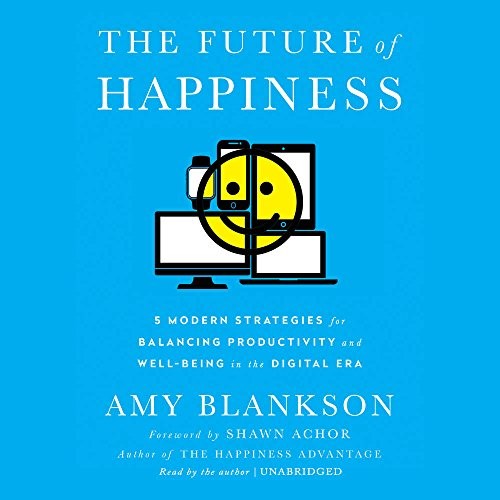
The Future of Happiness tackles a question that most positive psychology books sidestep: how do you cultivate well-being in an environment designed to capture your attention and monetize your anxiety? Amy Blankson, a co-founder of GoodThink and a sister of Shawn Achor, argues that technology is neither the enemy of happiness nor a neutral tool — it's a force that can be deliberately shaped to support well-being or to undermine it, depending almost entirely on how consciously you engage with it.
Blankson draws on the PERMA framework developed by Martin Seligman — positive emotions, engagement, relationships, meaning, and accomplishment — and asks how each pillar fares in a world of smartphones, social media, and always-on connectivity. The answers are mixed. Technology can enhance relationships through communication and shared experiences, but it can also fragment attention in ways that make genuine connection harder. It can support accomplishment through tracking and feedback, but it can also turn every goal into a performance anxiety trigger.
What it gets right
- 1.
Technology is not inherently good or bad for well-being — its effect depends almost entirely on how intentionally you engage with it.
- 2.
The PERMA framework applies directly to digital life: technology can enhance positive emotions, engagement, relationships, meaning, and accomplishment — or erode each.
- 3.
Passive social media consumption is consistently linked to lower well-being; active, connective use tends to be neutral or positive.
What it covers
Who wrote it
Amy Blankson is a positive psychology researcher and entrepreneur, co-founder of GoodThink, and a graduate of Harvard and the Yale School of Management. She is the sister of positive psychology researcher Shawn Achor and has worked with organizations including Google, the US Army, and NASA on applying well-being research to real-world settings. She sits on the board of the Digital Wellness Institute. The Future of Happiness is her first book and emerged from her work on the intersection of positive psychology and technology.
