Talk to The Geometry of Wealth like its author wrote you back.
Get the ideas that fit your life — not generic summaries.
- Chat with the book
- Audiobook-style main ideas
- Adapts to your life and goals
- Helps you take action
What it argues
The Geometry of Wealth is Brian Portnoy's attempt to rebuild the relationship between money and happiness on more defensible psychological foundations. Portnoy, an investment professional and behavioral finance researcher, opens with a distinction that drives the entire book: the difference between being rich and being wealthy. Rich is relative — having more than others, a moving target that tends to recede as you approach it. Wealthy, as Portnoy defines it, is "funded contentment" — having enough to support a life organized around what you actually value.
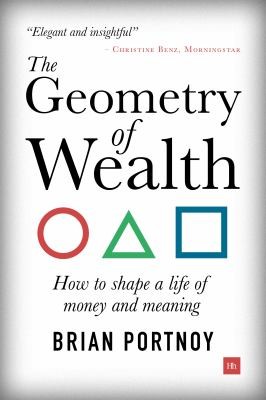
The book is structured around three geometric forms that represent three stages of financial maturity. The circle represents meaning — clarifying what you actually want your life to look like. The triangle represents money — the basic financial planning skills needed to fund that life. The square represents markets — the investment knowledge needed to grow and protect assets over time. Portnoy's argument is that most financial advice starts at the square (investment strategy) when the work should start at the circle (life design), and that this sequencing error is why so many financially successful people are not particularly happy.
What it gets right
- 1.
Funded contentment — having enough to support a life organized around your actual values — is a more achievable and durable target than being rich, which is inherently comparative and tends to recede as you approach it.
- 2.
Hedonic adaptation means people return to baseline happiness levels after both gains and losses faster than they expect. Accumulating more money above a sufficiency threshold has diminishing returns for well-being.
- 3.
Investment strategy is downstream of life design. Questions about risk, time horizon, and liquidity cannot be answered rationally until you know what the money is for.
What it covers
Who wrote it
Brian Portnoy is the founder of Shaping Wealth, a firm focused on financial education and behavioral coaching for investment professionals. Previously he spent two decades in the investment industry as a hedge fund analyst, fund-of-funds manager, and head of investor education at Morningstar. He holds a PhD in political science from the University of Chicago and has written and spoken extensively on the intersection of behavioral finance and well-being. He is also the author of The Investor's Paradox.
