The Geometry of Wealth by Brian Portnoy is a 2018 economics book about wealth psychology, life design, financial purpose. Funded contentment — having enough to support a life organized around your actual values — is a more achievable and durable target than being rich, which is inherently comparative and tends to recede as you approach it.
Summary
The Geometry of Wealth is Brian Portnoy's attempt to rebuild the relationship between money and happiness on more defensible psychological foundations. Portnoy, an investment professional and behavioral finance researcher, opens with a distinction that drives the entire book: the difference between being rich and being wealthy. Rich is relative — having more than others, a moving target that tends to recede as you approach it. Wealthy, as Portnoy defines it, is "funded contentment" — having enough to support a life organized around what you actually value.
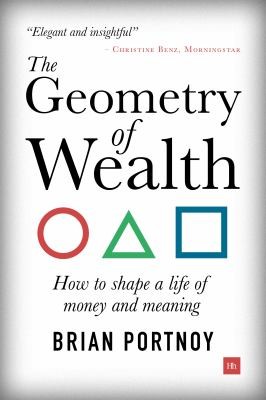
The book is structured around three geometric forms that represent three stages of financial maturity. The circle represents meaning — clarifying what you actually want your life to look like. The triangle represents money — the basic financial planning skills needed to fund that life. The square represents markets — the investment knowledge needed to grow and protect assets over time. Portnoy's argument is that most financial advice starts at the square (investment strategy) when the work should start at the circle (life design), and that this sequencing error is why so many financially successful people are not particularly happy.
The behavioral finance sections draw on decades of research into well-being, hedonic adaptation, and the psychology of goals. Portnoy's account of hedonic adaptation — the process by which people return to a baseline level of satisfaction regardless of gains or losses — is the strongest part of the book. The implication is uncomfortable: neither achieving financial goals nor losing them affects long-term happiness nearly as much as people anticipate. What does affect it is having close relationships, a sense of autonomy, and feeling that your days have meaning.
The investment sections are competent but less distinctive — diversify, keep costs low, control behavior. Where Portnoy adds value is in insisting that investment strategy is downstream of life design. Before you can make rational decisions about risk, time horizon, and liquidity, you need clarity about what the money is for. The geometry of the title is the suggestion that meaning, money, and markets are three distinct problems that have to be addressed in order.
Talk to The Geometry of Wealth like its author wrote you back.
Get the ideas that fit your life — not generic summaries.
- Chat with the book
- Audiobook-style main ideas
- Adapts to your life and goals
- Helps you take action
Key takeaways
- 1.
Funded contentment — having enough to support a life organized around your actual values — is a more achievable and durable target than being rich, which is inherently comparative and tends to recede as you approach it.
- 2.
Hedonic adaptation means people return to baseline happiness levels after both gains and losses faster than they expect. Accumulating more money above a sufficiency threshold has diminishing returns for well-being.
- 3.
Investment strategy is downstream of life design. Questions about risk, time horizon, and liquidity cannot be answered rationally until you know what the money is for.
- 4.
The three stages of financial maturity — meaning, money, markets — must be addressed in order. Most financial advice skips directly to markets without establishing the foundation that gives markets decisions their purpose.
- 5.
Basic financial competency (saving, debt management, insurance, emergency fund) is a prerequisite for wealth-building, yet most financial advice assumes these foundations are in place when they often are not.
- 6.
Autonomy — the sense that you are choosing how to spend your time — is one of the strongest predictors of subjective well-being. Money's primary value is often its ability to purchase autonomy rather than any specific consumption it enables.
- 7.
The pursuit of relative wealth — having more than others — is a reliable path to chronic dissatisfaction because the comparison group shifts with your wealth level.
- 8.
Most investors fail not because their strategy is wrong but because their goals are incoherent. Clarity about what you're investing for is more protective than marginal improvements to asset allocation.
Discussion questions
Use these on your own, with a book club, or as chat starters in Superbook. Book club version, ready to copy or print →
- 1.
Portnoy distinguishes being rich from being wealthy. Using his definition — funded contentment — are you wealthy by your own assessment? What would need to change for you to say yes?
- 2.
He argues that meaning must come before money decisions. Have you ever made a major financial decision — career, house, investment — without first being clear about what it was for?
- 3.
Hedonic adaptation says we return to baseline happiness regardless of gains or losses. Can you identify a financial achievement that delivered less lasting satisfaction than you expected?
- 4.
What is the minimum amount of money you need to feel adequate in your social context? Where did that number come from, and is it yours or borrowed from comparison?
- 5.
Autonomy — choosing how to spend your time — is a strong predictor of well-being. How much of your current financial behavior is aimed at purchasing more autonomy? How much at other things?
- 6.
Portnoy says most financial advice starts at markets (investment strategy) when it should start at meaning (life design). What is your life design, stated clearly enough to make financial decisions from?
- 7.
The book covers basic financial competency as a foundation often missing. Savings, emergency fund, insurance, debt management — do you have all four genuinely in order?
- 8.
He argues that chasing relative wealth is a reliable path to chronic dissatisfaction. Who are you currently comparing yourself to financially, and is that comparison helping you?
- 9.
Which of the three stages — meaning, money, or markets — is most underdeveloped in your own financial life?
- 10.
Portnoy is an investment professional who argues investment strategy matters less than most investors believe. How does that credential affect how you receive the argument?
- 11.
If you wrote down the five things that most reliably produce contentment in your daily life, how much of your current spending is in service of those five things?
- 12.
The book implies that most financial planning conversations happen in the wrong order. If you were designing a financial planning engagement from scratch, how would you sequence the questions?
Themes
Frequently asked questions
-
What is the main idea of The Geometry of Wealth?
That funded contentment — having enough to support a life organized around your actual values — is a more achievable and durable goal than accumulating wealth without knowing what it's for. Investment strategy is downstream of life design.
-
How long does it take to read?
Around four hours. The book is relatively short and the writing is accessible. The behavioral finance sections are the most information-dense; the life design sections are more reflective.
-
Is this a practical investment book?
Partially. The investment advice is competent but conventional — diversify, control costs, manage behavior. The book's distinctive contribution is the earlier sections on purpose and psychological well-being, which most investment books skip.
-
Who should read The Geometry of Wealth?
People who have financial resources but feel that their financial life is not particularly well-connected to what makes them happy. Also useful for financial advisors who want to have more meaningful conversations with clients about goals before strategy.
-
How does this compare to The Psychology of Money?
Both books address the behavioral and psychological dimensions of money. Housel's book is more narrative and story-driven; Portnoy's is more structured around a specific framework and draws more explicitly on academic well-being research.