Talk to The Goal: A Process of Ongoing Improvement like its author wrote you back.
Get the ideas that fit your life — not generic summaries.
- Chat with the book
- Audiobook-style main ideas
- Adapts to your life and goals
- Helps you take action
The Goal: A Process of Ongoing Improvement, in detail
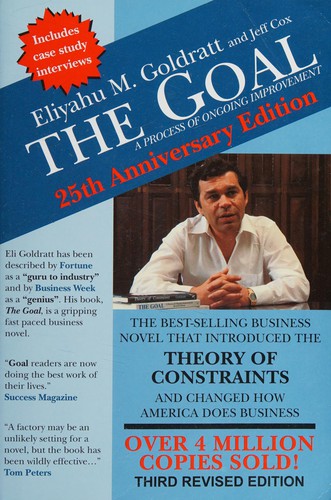
The Goal is a business novel — written as fiction to make operational management ideas accessible — that introduced the Theory of Constraints to a broad audience. Goldratt was a physicist turned management consultant, and he used the novel form to embed a rigorous set of ideas about how to manage production systems in a story that is genuinely readable. The protagonist, Alex Rogo, has ninety days to turn around a manufacturing plant or it will be shut down. His encounters with his old physics professor, Jonah, drive the intellectual arc of the book.
The central insight is disarmingly simple: every system has at least one constraint — a bottleneck — that limits the system's throughput. The manager's job is to identify the constraint, maximize its throughput, and then address the next constraint. Improvements to non-constraint parts of the system that don't increase the throughput of the constraint are largely wasted. This reframes the goal of operations from local efficiency (making every machine and worker as productive as possible) to global throughput (producing more of what the system is designed to produce).
The corollary ideas are equally counterintuitive. Inventory is not an asset when it accumulates in front of a non-constraint — it is a sign of imbalance. Statistical fluctuations in dependent processes compound in ways that make the system worse than any individual component's performance suggests. Activating a resource (using it) is not the same as utilizing it (making it productive toward the goal). These distinctions change how a plant manager — or any manager of a constrained system — should think about the measurements that matter.
Goldratt and Cox made a deliberate choice not to provide all the answers in the book — Jonah asks questions rather than giving instructions — both because the Socratic method is pedagogically intentional and because the answers vary by context. The Theory of Constraints, formalized in subsequent books like The Race and It's Not Luck, has been applied far beyond manufacturing to software development, project management, and sales.
The big ideas
- 1.
Every system has at least one constraint. The throughput of the system is limited by the constraint, and improving non-constraints without improving the constraint does not improve the system.
- 2.
The five focusing steps of Theory of Constraints: identify the constraint, decide how to exploit it, subordinate everything else to the constraint, elevate the constraint, then find the next constraint.
- 3.
Activating a resource (using it) is not the same as utilizing it (directing it toward the system's goal). Idle time at a non-constraint is not waste if it prevents buildup in front of the constraint.
