The Goal: A Process of Ongoing Improvement by Eliyahu M. Goldratt and Jeff Cox is a 1984 business book about operations, strategy, systems thinking. Every system has at least one constraint. The throughput of the system is limited by the constraint, and improving non-constraints without improving the constraint does not improve the system.
Summary
The Goal is a business novel — written as fiction to make operational management ideas accessible — that introduced the Theory of Constraints to a broad audience. Goldratt was a physicist turned management consultant, and he used the novel form to embed a rigorous set of ideas about how to manage production systems in a story that is genuinely readable. The protagonist, Alex Rogo, has ninety days to turn around a manufacturing plant or it will be shut down. His encounters with his old physics professor, Jonah, drive the intellectual arc of the book.
The central insight is disarmingly simple: every system has at least one constraint — a bottleneck — that limits the system's throughput. The manager's job is to identify the constraint, maximize its throughput, and then address the next constraint. Improvements to non-constraint parts of the system that don't increase the throughput of the constraint are largely wasted. This reframes the goal of operations from local efficiency (making every machine and worker as productive as possible) to global throughput (producing more of what the system is designed to produce).
The corollary ideas are equally counterintuitive. Inventory is not an asset when it accumulates in front of a non-constraint — it is a sign of imbalance. Statistical fluctuations in dependent processes compound in ways that make the system worse than any individual component's performance suggests. Activating a resource (using it) is not the same as utilizing it (making it productive toward the goal). These distinctions change how a plant manager — or any manager of a constrained system — should think about the measurements that matter.
Goldratt and Cox made a deliberate choice not to provide all the answers in the book — Jonah asks questions rather than giving instructions — both because the Socratic method is pedagogically intentional and because the answers vary by context. The Theory of Constraints, formalized in subsequent books like The Race and It's Not Luck, has been applied far beyond manufacturing to software development, project management, and sales.
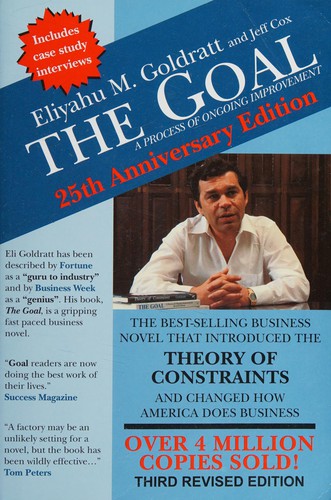
Talk to The Goal: A Process of Ongoing Improvement like its author wrote you back.
Get the ideas that fit your life — not generic summaries.
- Chat with the book
- Audiobook-style main ideas
- Adapts to your life and goals
- Helps you take action
Key takeaways
- 1.
Every system has at least one constraint. The throughput of the system is limited by the constraint, and improving non-constraints without improving the constraint does not improve the system.
- 2.
The five focusing steps of Theory of Constraints: identify the constraint, decide how to exploit it, subordinate everything else to the constraint, elevate the constraint, then find the next constraint.
- 3.
Activating a resource (using it) is not the same as utilizing it (directing it toward the system's goal). Idle time at a non-constraint is not waste if it prevents buildup in front of the constraint.
- 4.
Statistical fluctuations in dependent processes compound — the best-case scenario at each step is not achievable simultaneously, and the average performance of the system is worse than the average of its parts.
- 5.
Inventory in front of a constraint is a symptom of imbalance. Carrying it costs money and hides the real problem rather than solving it.
- 6.
The goal of a business is to make money. Goldratt is explicit: not to be efficient, not to be productive, but to generate throughput while minimizing inventory and operating expense.
- 7.
Throughput (the rate at which the system generates money through sales), Inventory (what is invested to turn materials into throughput), and Operating Expense (the cost of that conversion) are the three measurements that matter.
- 8.
Finding the constraint requires observation of the actual system, not reliance on standard accounting metrics. What shows up as a problem on the factory floor is often caused by a constraint elsewhere in the system.
Discussion questions
Use these on your own, with a book club, or as chat starters in Superbook. Book club version, ready to copy or print →
- 1.
What is the constraint in a system you work within or manage? Is it a physical bottleneck, a policy, or a measurement that directs behavior toward local rather than global efficiency?
- 2.
Goldratt says improving non-constraints doesn't improve the system. Have you seen investment in efficiency improvements that didn't help — or that actually hurt — overall throughput?
- 3.
The novel form is unusual for a business book. What did reading The Goal as fiction do to your understanding of the ideas compared to reading them as analysis?
- 4.
Goldratt uses a hiking trip with Boy Scouts as the analogy for dependent processes and statistical fluctuations. Where else in business or life do you see dependent processes compounding in the same way?
- 5.
The Theory of Constraints focuses on throughput, inventory, and operating expense. How does this differ from standard cost accounting, and when does the difference matter most?
- 6.
Goldratt argues that idle time at a non-constraint is not waste. That directly contradicts most management instincts about utilization. When is that counterintuitive claim most important to act on?
- 7.
The five focusing steps assume you can identify the constraint. What makes constraint identification difficult in complex or non-manufacturing systems?
- 8.
How does the Theory of Constraints apply to software development? What is the constraint in a typical software development pipeline, and how would you exploit it?
- 9.
Goldratt's Jonah refuses to give Alex the answers and instead asks questions. What's the pedagogical argument for that approach, and does it match your experience of how people actually learn?
- 10.
The book was first published in 1984 and set in a manufacturing plant. What has changed about its relevance since then, and what has stayed the same?
- 11.
What would it mean to apply the Theory of Constraints to a professional services firm, a marketing department, or your own personal workflow?
Themes
Frequently asked questions
-
Is The Goal worth reading?
Yes. It remains one of the most effective ways to learn the Theory of Constraints, and the novel format makes ideas about operational management accessible that most readers would find dry as traditional analysis. The plant management setting is not limiting — the ideas transfer broadly.
-
What is the Theory of Constraints?
A management philosophy based on the insight that every system has at least one constraint that limits its throughput. Improvement should focus on identifying and exploiting that constraint rather than optimizing non-constraints. The five focusing steps provide the systematic method.
-
Do I need manufacturing experience to understand The Goal?
No. The novel structure is specifically designed to be accessible without background. The factory setting provides concrete metaphors for abstract systems ideas that transfer to any organization managing a flow of work.
-
How does The Goal relate to lean manufacturing and Six Sigma?
Theory of Constraints, lean, and Six Sigma address related but distinct problems. TOC focuses on identifying and exploiting system constraints. Lean focuses on eliminating waste from processes. Six Sigma focuses on reducing process variation. Many operations professionals use all three as complementary frameworks.
-
What should I read after The Goal?
Goldratt's Critical Chain applies the theory to project management. The Phoenix Project applies it to software development and DevOps. Eliyahu Goldratt's later work, including It's Not Luck, extends the theory to strategy and marketing.
Similar books
Traction: Get a Grip on Your Business
Gino Wickman
The Phoenix Project: A Novel About IT, DevOps, and Helping Your Business Win
Gene Kim, Kevin Behr, and George Spafford
The Lean Startup
Eric Ries
Good Strategy Bad Strategy
Richard Rumelt
