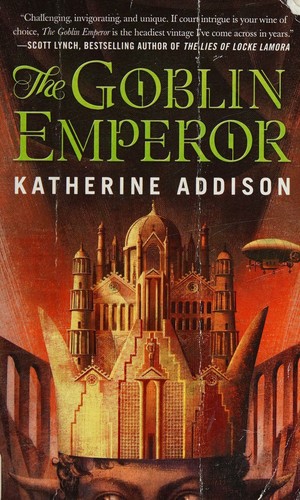
Talk to The Goblin Emperor like its author wrote you back.
Get the ideas that fit your life — not generic summaries.
- Chat with the book
- Audiobook-style main ideas
- Adapts to your life and goals
- Helps you take action
The Goblin Emperor, in detail
The Goblin Emperor begins with an accident: Maia, the half-goblin, half-elf youngest son of the Emperor — long exiled to a remote estate and treated as an embarrassment — learns that his father and three brothers have been killed in an airship crash. He is now Emperor of the Elflands, a position for which he has received no preparation and which nearly everyone expects him to fail. The novel follows his first months on the throne, navigating court politics, assassination plots, the slow accumulation of allies, and the daily labor of trying to rule well when you don't know the rules.
The Goblin Emperor is fundamentally about whether decency is a viable political strategy. Maia's defining characteristic is not cleverness or power — it's that he genuinely tries to treat people with kindness, even when the system around him rewards cruelty and condescension. The court is structured around hierarchy, protocol, and the performance of power; Maia keeps breaking those rules not through ignorance but because he can't stop noticing the people inside the machinery. The book asks whether someone like that can survive, let alone govern.
Katherine Addison (a pen name for Sarah Monette) writes the court with real depth. The elaborate naming and honorific systems are a commitment — there's a glossary, and you'll want to use it — but they reflect something true about how power is performed through language. The world has airships and mechanical clockwork alongside traditional court fantasy elements, which adds flavor without distracting from the character study at its center.
The Goblin Emperor is often described as "cozy fantasy," a term that understates it. The book is genuinely warm, and it is also genuinely complicated — about loneliness, about the cost of trying to be good in a bad system, about what it means to hold power over people who don't want you to. It is not a comfort read in the sense of being unchallenging. It is a comfort read in the sense that the protagonist's moral orientation is the novel's and the novel's is yours. That's rarer than it sounds.
The big ideas
- 1.
Maia's decency is not naivety. The novel carefully distinguishes between kindness born from strength and kindness born from weakness, and argues Maia's is the former.
- 2.
The elaborate court protocols and naming systems serve a purpose: they show how power maintains itself through performance, and how Maia's fumbling with them is both a liability and a kind of honesty.
- 3.
Loneliness is Maia's defining experience before the throne and remains so after it. Power doesn't solve isolation; in many ways it intensifies it. The book takes this seriously.
