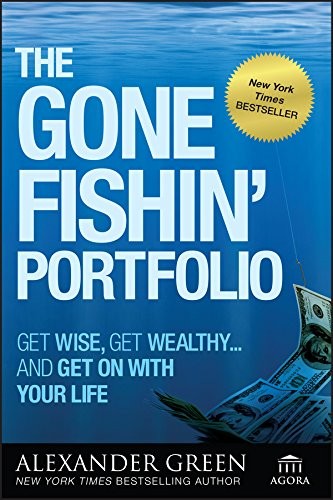
Talk to The Gone Fishin' Portfolio like its author wrote you back.
Get the ideas that fit your life — not generic summaries.
- Chat with the book
- Audiobook-style main ideas
- Adapts to your life and goals
- Helps you take action
The Gone Fishin' Portfolio, in detail
The Gone Fishin' Portfolio is Alexander Green's case for a specific ten-fund, low-cost, passively managed portfolio designed to be set up once, rebalanced annually, and otherwise left alone. The title captures the philosophy: once built correctly, the portfolio requires almost no ongoing attention, freeing the investor to do something else — even go fishing. Green argues that most individual investors' attempts to beat the market through stock selection, market timing, or active fund management cost them returns, and that a diversified passive approach outperforms the great majority of managed money over any meaningful time horizon.
Green's proposed allocation spreads investments across domestic and international equities, bonds, real estate investment trusts, and natural resources in specific percentages. He draws on Harry Markowitz's modern portfolio theory to justify the allocations, particularly the insight that combining assets with low or negative correlations can improve risk-adjusted returns without sacrificing expected gains. The book explains the theory accessibly before getting to the practical mechanics, which is useful for readers new to portfolio construction.
Beyond the specific portfolio, Green covers the standard case against active management: high fees, the difficulty of selecting outperforming managers in advance, and the tax costs of frequent trading. He also addresses behavior — the tendency of individual investors to buy high and sell low, chasing recent performance rather than maintaining discipline through market cycles. The annual rebalancing discipline is as much a behavioral tool as a financial one: it forces selling what has risen and buying what has fallen, the opposite of what most people's instincts tell them to do.
The book's limitation is its specificity. The Gone Fishin' Portfolio is presented as a near-universal solution, and the confidence can feel overstated given how much individual circumstances vary. Asset allocations appropriate for a thirty-year-old in accumulation phase differ from those appropriate for someone five years from retirement. Green acknowledges this only briefly. Still, for a reader who wants a concrete, evidence-based starting point with minimal complexity, the portfolio provides a defensible default that beats most people's improvised alternatives.
The big ideas
- 1.
A simple, diversified, low-cost passive portfolio outperforms most actively managed alternatives over long periods after accounting for fees and taxes.
- 2.
Modern portfolio theory shows that combining assets with low correlations improves risk-adjusted returns — diversification is the only free lunch in investing.
- 3.
The main enemy of returns for most investors is not bad markets but bad behavior: chasing performance, panic-selling, and overtrading.
