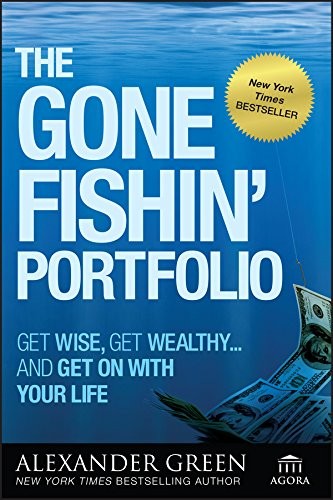
The Gone Fishin' Portfolio by Alexander Green is a 2008 economics book about asset allocation, passive investing, retirement planning. A simple, diversified, low-cost passive portfolio outperforms most actively managed alternatives over long periods after accounting for fees and taxes.
Summary
The Gone Fishin' Portfolio is Alexander Green's case for a specific ten-fund, low-cost, passively managed portfolio designed to be set up once, rebalanced annually, and otherwise left alone. The title captures the philosophy: once built correctly, the portfolio requires almost no ongoing attention, freeing the investor to do something else — even go fishing. Green argues that most individual investors' attempts to beat the market through stock selection, market timing, or active fund management cost them returns, and that a diversified passive approach outperforms the great majority of managed money over any meaningful time horizon.
Green's proposed allocation spreads investments across domestic and international equities, bonds, real estate investment trusts, and natural resources in specific percentages. He draws on Harry Markowitz's modern portfolio theory to justify the allocations, particularly the insight that combining assets with low or negative correlations can improve risk-adjusted returns without sacrificing expected gains. The book explains the theory accessibly before getting to the practical mechanics, which is useful for readers new to portfolio construction.
Beyond the specific portfolio, Green covers the standard case against active management: high fees, the difficulty of selecting outperforming managers in advance, and the tax costs of frequent trading. He also addresses behavior — the tendency of individual investors to buy high and sell low, chasing recent performance rather than maintaining discipline through market cycles. The annual rebalancing discipline is as much a behavioral tool as a financial one: it forces selling what has risen and buying what has fallen, the opposite of what most people's instincts tell them to do.
The book's limitation is its specificity. The Gone Fishin' Portfolio is presented as a near-universal solution, and the confidence can feel overstated given how much individual circumstances vary. Asset allocations appropriate for a thirty-year-old in accumulation phase differ from those appropriate for someone five years from retirement. Green acknowledges this only briefly. Still, for a reader who wants a concrete, evidence-based starting point with minimal complexity, the portfolio provides a defensible default that beats most people's improvised alternatives.
Talk to The Gone Fishin' Portfolio like its author wrote you back.
Get the ideas that fit your life — not generic summaries.
- Chat with the book
- Audiobook-style main ideas
- Adapts to your life and goals
- Helps you take action
Key takeaways
- 1.
A simple, diversified, low-cost passive portfolio outperforms most actively managed alternatives over long periods after accounting for fees and taxes.
- 2.
Modern portfolio theory shows that combining assets with low correlations improves risk-adjusted returns — diversification is the only free lunch in investing.
- 3.
The main enemy of returns for most investors is not bad markets but bad behavior: chasing performance, panic-selling, and overtrading.
- 4.
Annual rebalancing forces disciplined buy-low, sell-high behavior by systematically trimming winners and adding to laggards.
- 5.
Investment costs compound just like returns — a 1% difference in fees represents a large fraction of terminal wealth over a 30-year horizon.
- 6.
The gone fishin' approach works precisely because it removes most decisions: the plan is made once and executed mechanically, reducing the opportunity for costly emotional choices.
- 7.
International diversification reduces the risk of home-country concentration without necessarily reducing expected returns.
- 8.
Real assets like REITs and commodities provide inflation protection and low correlation with equities, improving portfolio robustness across economic environments.
Discussion questions
Use these on your own, with a book club, or as chat starters in Superbook. Book club version, ready to copy or print →
- 1.
Green argues that most investors' attempts to outperform the market hurt them. Does that match your own experience with picking stocks or active funds?
- 2.
How much attention do you currently give to your investments? Does it add value or mostly create opportunities for behavioral mistakes?
- 3.
What would it actually take for you to adopt a set-and-forget approach? What psychological barriers make that difficult?
- 4.
His specific portfolio has fixed percentages for each asset class. How would you feel watching one segment drop 40% in a downturn while your friends sold everything?
- 5.
Have you ever sold investments out of fear or bought out of excitement? What did that decision cost you in hindsight?
- 6.
Green puts significant weight on keeping costs low. Have you calculated the total annual cost of your current investment mix?
- 7.
The rebalancing rule — sell what's up, buy what's down — feels counterintuitive. What would make it easier to follow systematically?
- 8.
International stocks have underperformed US stocks in some extended periods. Does that make you more or less confident in the diversification argument?
- 9.
How much of your current portfolio reflects deliberate allocation versus accumulated decisions that made sense at the time?
- 10.
Green writes for investors who want simplicity. Where does simplicity stop being a virtue in investing and require more customization?
- 11.
What would you do differently in your current portfolio if you were starting from scratch today?
Themes
Frequently asked questions
-
What exactly is the Gone Fishin' Portfolio?
It's a specific ten-fund allocation spread across US and international equities, bonds, real estate investment trusts, and natural resources, using low-cost index funds. The allocation is designed to be set up once and rebalanced annually with minimal ongoing management or monitoring required.
-
Is The Gone Fishin' Portfolio still relevant?
The core principles — low-cost passive investing, broad diversification, annual rebalancing, behavioral discipline — remain as valid as when Green wrote them. The specific fund choices may have better options today given the proliferation of ETFs, but the framework holds up.
-
How complicated is the portfolio to implement?
Not very. Ten funds held at a single brokerage account, with annual rebalancing back to target percentages. The main practical challenge is automating contributions and not checking the portfolio so often that you're tempted to tinker.
-
Who should read this book?
Investors who want a simple, evidence-backed approach and are willing to stop trying to pick winners or time markets. Particularly useful for people who feel overwhelmed by investment complexity and want a concrete, defensible plan they can actually stick to.
-
What's the book's biggest weakness?
The one-size-fits-all framing. Green presents the portfolio as appropriate for nearly everyone without adequately addressing how life stage, income stability, risk tolerance, and tax situation should influence allocation. The general principles are sound; the specific percentages need individual adjustment.
Similar books
A Random Walk Down Wall Street
Burton G. Malkiel
The Bogleheads' Guide to Investing
Taylor Larimore
The Little Book of Common Sense Investing
John C. Bogle
The Simple Path to Wealth
JL Collins
