Talk to The Good Ancestor like its author wrote you back.
Get the ideas that fit your life — not generic summaries.
- Chat with the book
- Audiobook-style main ideas
- Adapts to your life and goals
- Helps you take action
The Good Ancestor, in detail
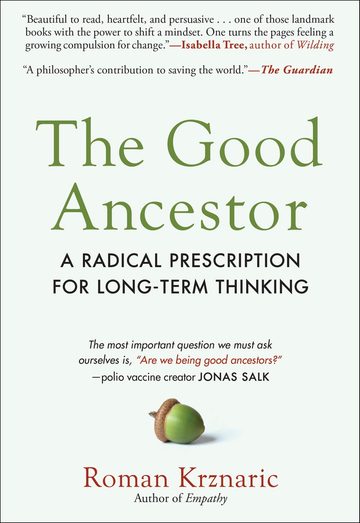
The Good Ancestor is Roman Krznaric's case for extending our sense of moral and practical obligation across time — not just to the people alive today but to those who will come after us. Published in 2020, it argues that humanity is suffering from a pathological short-termism: political cycles rewarding quarterly thinking, financial markets discounting the future, and media environments training attention to the urgent at the expense of the important. The result is a civilization that cannibalizes its own future while believing it is acting rationally.
Krznaric's argument is philosophical but deliberately practical. He is not interested in abstract obligations to posterity; he wants specific cognitive tools and institutional designs that make long-term thinking less exceptional and more habitual. The book is organized around what he calls six pathways for becoming a good ancestor: cathedral thinking (planning projects whose completion you won't see), holistic forecasting (imagining multiple futures rather than extrapolating from trends), legacy mindset (asking what your actions will look like from a hundred years out), intergenerational justice (treating future people as rights-holders, not abstractions), transcendent goal setting (commitments to goals larger than personal success), and finding your deep purpose in relation to deep time.
The examples range widely: Iroquois law's requirement to consider seven generations in decisions, the Onkalo nuclear waste repository in Finland designed to last 100,000 years, the Long Now Foundation's 10,000-year clock. These concrete cases are among the book's best material — they show that long-term thinking is not merely theoretical but has been practiced in different forms across cultures and can be institutionalized.
Krznaric is honest that short-termism has structural causes that individual mindset changes cannot fix alone. The second half of the book engages with questions of governance: courts for future generations, changes to legislative incentives, reform of financial systems that discount the future. This is where the analysis grows thinner — the prescriptions are real but the obstacles are underweighted. As a prompt for thinking about your own relationship to time and legacy, the book is genuinely valuable. As a blueprint for systemic change, it sets up the challenge more usefully than it resolves it.
The big ideas
- 1.
Pathological short-termism — optimizing for immediate outcomes at the expense of longer ones — is built into the incentive structures of democratic politics, financial markets, and media, not just individual psychology.
- 2.
Cathedral thinking names the capacity to begin projects whose benefits will come generations after their authors are dead — a mode of commitment rare in contemporary life but historically commonplace.
- 3.
The Iroquois Confederacy's tradition of considering the seventh generation in decisions is an example of institutionalized long-term thinking that modern democracies have largely abandoned.
