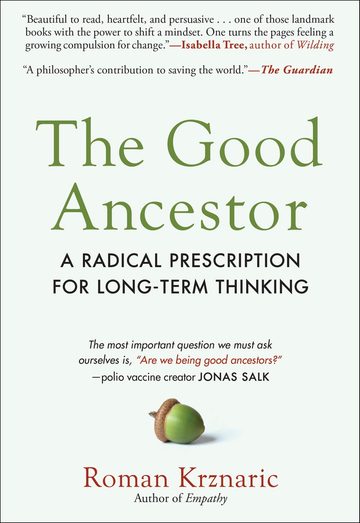
The Good Ancestor by Roman Krznaric is a 2020 philosophy book about long-term thinking, future generations, time horizon. Pathological short-termism — optimizing for immediate outcomes at the expense of longer ones — is built into the incentive structures of democratic politics, financial markets, and media, not just individual psychology.
Summary
The Good Ancestor is Roman Krznaric's case for extending our sense of moral and practical obligation across time — not just to the people alive today but to those who will come after us. Published in 2020, it argues that humanity is suffering from a pathological short-termism: political cycles rewarding quarterly thinking, financial markets discounting the future, and media environments training attention to the urgent at the expense of the important. The result is a civilization that cannibalizes its own future while believing it is acting rationally.
Krznaric's argument is philosophical but deliberately practical. He is not interested in abstract obligations to posterity; he wants specific cognitive tools and institutional designs that make long-term thinking less exceptional and more habitual. The book is organized around what he calls six pathways for becoming a good ancestor: cathedral thinking (planning projects whose completion you won't see), holistic forecasting (imagining multiple futures rather than extrapolating from trends), legacy mindset (asking what your actions will look like from a hundred years out), intergenerational justice (treating future people as rights-holders, not abstractions), transcendent goal setting (commitments to goals larger than personal success), and finding your deep purpose in relation to deep time.
The examples range widely: Iroquois law's requirement to consider seven generations in decisions, the Onkalo nuclear waste repository in Finland designed to last 100,000 years, the Long Now Foundation's 10,000-year clock. These concrete cases are among the book's best material — they show that long-term thinking is not merely theoretical but has been practiced in different forms across cultures and can be institutionalized.
Krznaric is honest that short-termism has structural causes that individual mindset changes cannot fix alone. The second half of the book engages with questions of governance: courts for future generations, changes to legislative incentives, reform of financial systems that discount the future. This is where the analysis grows thinner — the prescriptions are real but the obstacles are underweighted. As a prompt for thinking about your own relationship to time and legacy, the book is genuinely valuable. As a blueprint for systemic change, it sets up the challenge more usefully than it resolves it.
Talk to The Good Ancestor like its author wrote you back.
Get the ideas that fit your life — not generic summaries.
- Chat with the book
- Audiobook-style main ideas
- Adapts to your life and goals
- Helps you take action
Key takeaways
- 1.
Pathological short-termism — optimizing for immediate outcomes at the expense of longer ones — is built into the incentive structures of democratic politics, financial markets, and media, not just individual psychology.
- 2.
Cathedral thinking names the capacity to begin projects whose benefits will come generations after their authors are dead — a mode of commitment rare in contemporary life but historically commonplace.
- 3.
The Iroquois Confederacy's tradition of considering the seventh generation in decisions is an example of institutionalized long-term thinking that modern democracies have largely abandoned.
- 4.
Treating future generations as rights-holders — not abstractions to be traded off against present interests — is a philosophical shift with real institutional implications, including the creation of commissioners or courts for future generations.
- 5.
Holistic forecasting means developing multiple distinct futures rather than projecting single trends — a discipline that makes the present moment look less inevitable and more chosen.
- 6.
The deep time perspective — seeing oneself as part of a lineage stretching back hundreds of thousands of years and forward into deep time — changes what feels urgent and what feels important.
- 7.
Legacy is a motivational resource: asking what your actions will look like to people living a hundred years from now changes which actions seem worthwhile.
- 8.
Short-termism is not universal: many indigenous governance systems, religious institutions, and engineering projects have successfully maintained long-term commitments. The capacity exists; the problem is institutional design.
Discussion questions
Use these on your own, with a book club, or as chat starters in Superbook. Book club version, ready to copy or print →
- 1.
Krznaric argues that democratic politics structurally rewards short-term thinking. Do you agree? Can you think of examples from your own country that support or complicate this?
- 2.
Cathedral thinking involves committing to projects whose completion you won't see. What is the most cathedral-like project you've been involved in? How did the long horizon change how you worked on it?
- 3.
The Iroquois seven-generation principle means considering impacts seven generations out. What decision in your own life or work would look different if you applied that standard?
- 4.
The book argues that future people should be treated as rights-holders, not just interests to be considered. What would that actually require of governments? And what would it require of individuals?
- 5.
Krznaric distinguishes holistic forecasting — imagining multiple futures — from extrapolation. When you think about the future of your field or country, are you extrapolating or genuinely imagining alternatives?
- 6.
The deep time perspective — situating yourself in a lineage going back hundreds of thousands of years — sounds abstract. Has thinking about deep time ever actually changed how you acted? If not, why not?
- 7.
Legacy is offered as a motivational tool: thinking about how your actions look from a century out. Is that motivating or paralyzing for you? What is the difference between a healthy legacy mindset and anxiety about the future?
- 8.
Short-termism has structural causes. If individual mindset changes aren't enough, what institutional changes would be most likely to lengthen time horizons in the places that matter most?
- 9.
The Finland nuclear waste repository — designed to warn people 100,000 years in the future — is one of the book's most striking examples. What does it reveal about the difficulty of long-term thinking at civilizational scale?
- 10.
Krznaric is optimistic that we can change. Is that optimism earned? What evidence would shift your assessment of whether long-term thinking can actually be institutionalized?
- 11.
Which of Krznaric's six pathways feels most applicable to your own situation? What would you have to change to make it a habit?
Themes
Frequently asked questions
-
What is The Good Ancestor about?
It argues that modern societies are structurally short-termist — optimizing for present outcomes at the expense of future generations — and offers both a philosophical case and practical tools for extending our time horizon to become better ancestors to the people who will come after us.
-
Is this a self-help book or a policy book?
It straddles both. Some chapters are about individual mindset and motivation — how to think of yourself as part of a longer story. Others are about institutional design — courts for future generations, changes to financial discounting. The personal and structural arguments don't always connect smoothly.
-
Is The Good Ancestor worth reading?
Yes, particularly if you've felt unsatisfied with 'live in the moment' approaches to life or frustrated that important long-term problems get less attention than immediate ones. The concept of cathedral thinking alone is worth the read.
-
Who should read this book?
People working on long-timescale problems — climate, infrastructure, education, policy — will find it directly useful. Anyone feeling that modern life is too dominated by the urgent at the expense of the important will recognize the argument immediately.
-
How does it compare to Four Thousand Weeks?
Four Thousand Weeks focuses on individual mortality and the personal relationship with time. The Good Ancestor is more concerned with collective timescales and what we owe future generations. They complement each other well.
Similar books
Four Thousand Weeks: Time Management for Mortals
Oliver Burkeman
Thinking in Systems
Donella H. Meadows
Enlightenment Now
Steven Pinker
The Sixth Extinction: An Unnatural History
Elizabeth Kolbert
