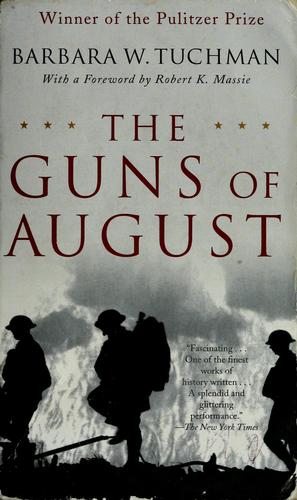
Talk to The Guns of August like its author wrote you back.
Get the ideas that fit your life — not generic summaries.
- Chat with the book
- Audiobook-style main ideas
- Adapts to your life and goals
- Helps you take action
What it argues
The Guns of August covers the first month of the First World War — from the funeral of King Edward VII in May 1910 to the stalled offensives of September 1914 — with a level of narrative authority and moral clarity that has made it the defining popular history of the war's opening disaster. Barbara Tuchman's central argument is that the war's catastrophic scale was not inevitable but was the product of particular decisions made under pressure by leaders who misread their opponents, believed their own war plans too completely, and proved unable to adapt when reality contradicted expectation.
The book's structural core is the Schlieffen Plan, Germany's blueprint for a two-front war against France and Russia. The plan required a rapid sweep through neutral Belgium to knock France out of the war before Russia could mobilize in the east. It was a brilliant piece of military engineering — and it depended on assumptions about timing, French response, and Belgian resistance that turned out to be wrong. The German army came close, then failed, partly due to battlefield exhaustion, partly due to a single-day deviation by General von Kluck that the French exploited. The Marne stopped the Schlieffen Plan and, with it, any prospect of the short war Germany had planned.
What it gets right
- 1.
The First World War began with a cascade of mobilizations that no single leader wanted but no leader found a way to stop. Military timetables and alliance commitments removed decision space once the crisis began.
- 2.
The Schlieffen Plan required Germany to violate Belgian neutrality, which brought Britain into the war. The calculation that Britain would not fight, or would fight too late to matter, was one of the plan's foundational miscalculations.
- 3.
The German army came within a day's march of Paris before the Battle of the Marne reversed its advance. Von Kluck's deviation from the prescribed route created the gap the French and British exploited.
What it covers
Who wrote it
Barbara Tuchman (1912–1989) was an American historian and two-time Pulitzer Prize winner whose books combined scholarly rigor with narrative accessibility. She won Pulitzers for The Guns of August (1963) and Stilwell and the American Experience in China (1972). Her other major works include A Distant Mirror, on the fourteenth century, and The March of Folly, on governmental self-defeat across history. She worked as a journalist before turning to history and never held an academic position, which shaped her commitment to writing for general readers and to making serious scholarship accessible.
