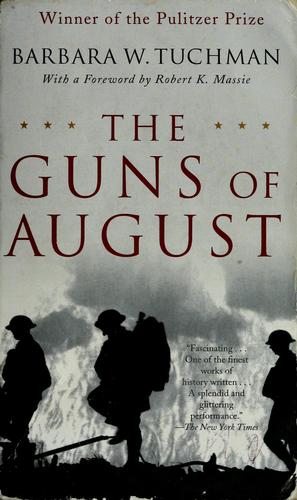
The Guns of August by Barbara Tuchman is a 1962 history book about world war i, military strategy, political miscalculation. The First World War began with a cascade of mobilizations that no single leader wanted but no leader found a way to stop. Military timetables and alliance commitments removed decision space once the crisis began.
Summary
The Guns of August covers the first month of the First World War — from the funeral of King Edward VII in May 1910 to the stalled offensives of September 1914 — with a level of narrative authority and moral clarity that has made it the defining popular history of the war's opening disaster. Barbara Tuchman's central argument is that the war's catastrophic scale was not inevitable but was the product of particular decisions made under pressure by leaders who misread their opponents, believed their own war plans too completely, and proved unable to adapt when reality contradicted expectation.
The book's structural core is the Schlieffen Plan, Germany's blueprint for a two-front war against France and Russia. The plan required a rapid sweep through neutral Belgium to knock France out of the war before Russia could mobilize in the east. It was a brilliant piece of military engineering — and it depended on assumptions about timing, French response, and Belgian resistance that turned out to be wrong. The German army came close, then failed, partly due to battlefield exhaustion, partly due to a single-day deviation by General von Kluck that the French exploited. The Marne stopped the Schlieffen Plan and, with it, any prospect of the short war Germany had planned.
Tuchman is equally sharp on the Allied side. The French army went into the war committed to the offensive, convinced that élan — fighting spirit — would compensate for firepower differentials. The opening battles in Alsace and the Ardennes killed that doctrine and tens of thousands of French soldiers simultaneously. The British Expeditionary Force was small, professional, and tactically excellent — and nearly destroyed by the retreat from Mons before it could matter. The early weeks of the war consumed the professional armies of 1914; what followed was four years of improvised mass slaughter.
Kennedy, who recommended the book during the Cuban Missile Crisis as a lesson in how miscalculation can cascade into catastrophe, captured something essential about it. Tuchman is not writing a structural analysis of why the war happened — she credits Christopher Clark's later work would occupy that ground — but a study of how it unfolded once it started, and why the leaders who had the most to lose from a long war found themselves trapped in one. The Guns of August is history as tragedy: not inevitable, but by the time you see where it's heading, already too late to stop.
Talk to The Guns of August like its author wrote you back.
Get the ideas that fit your life — not generic summaries.
- Chat with the book
- Audiobook-style main ideas
- Adapts to your life and goals
- Helps you take action
Key takeaways
- 1.
The First World War began with a cascade of mobilizations that no single leader wanted but no leader found a way to stop. Military timetables and alliance commitments removed decision space once the crisis began.
- 2.
The Schlieffen Plan required Germany to violate Belgian neutrality, which brought Britain into the war. The calculation that Britain would not fight, or would fight too late to matter, was one of the plan's foundational miscalculations.
- 3.
The German army came within a day's march of Paris before the Battle of the Marne reversed its advance. Von Kluck's deviation from the prescribed route created the gap the French and British exploited.
- 4.
The French army's doctrine of offensive à outrance — attack at all costs — produced catastrophic losses in the opening weeks. Tens of thousands of soldiers died proving a theory wrong that its adherents had mistaken for a law.
- 5.
Britain entered the war with a small but highly professional army. The BEF's near-destruction at Mons and during the retreat meant that the professional core was largely gone before the war found its character.
- 6.
Communication failures, staff rigidity, and the inability of commanders to adapt their plans in real time were as important as any tactical decision. The generals of 1914 were managing forces too large and too fast-moving for the command technologies they had.
- 7.
Tuchman's account implies, without quite stating, that no leader on any side understood what the war would become. They planned for a short war, optimized for the first six weeks, and then had no framework for what followed.
- 8.
Kennedy reportedly gave the book to his ExComm during the Cuban Missile Crisis as a lesson in escalation dynamics. Tuchman's account of how war begins makes the mechanism of miscalculation as vivid as any abstract analysis.
Discussion questions
Use these on your own, with a book club, or as chat starters in Superbook. Book club version, ready to copy or print →
- 1.
Tuchman describes leaders who knew war was catastrophic but couldn't find a way out once mobilizations began. How much of World War I was structural — built into alliances and war plans — and how much depended on individual decisions?
- 2.
The Schlieffen Plan required violating Belgian neutrality, which brought Britain in. Was there a version of German strategy that could have kept Britain neutral, and would it have changed the war's outcome?
- 3.
The French army's offensive doctrine cost hundreds of thousands of lives in the first weeks. How do you explain the persistence of a military doctrine in the face of evidence that it doesn't work?
- 4.
Kennedy reportedly gave The Guns of August to his advisors during the Cuban Missile Crisis. What lessons about escalation and miscalculation is he suggesting they should take from it?
- 5.
Tuchman focuses on the opening month, not the causes of the war. Does that framing help or limit the book's usefulness as history?
- 6.
Von Moltke, the German chief of staff, deviated from Schlieffen's plan under pressure and arguably lost the war in doing so. When is it right to stick to a plan under pressure, and when should you adapt?
- 7.
Communication breakdowns were as important as any tactical decision. How does the availability of real-time communication today change — or not change — the dynamics of military and political decision-making under pressure?
- 8.
Every side entered the war expecting a short conflict. What does that shared miscalculation suggest about the limits of military and political planning?
- 9.
Tuchman writes popular history with a strong narrative voice. Does her sympathy for certain figures — Joffre, French, certain German officers — affect the credibility of her analysis?
- 10.
The professional armies of 1914 were largely destroyed in the first months. How did that loss shape the character of the war that followed?
- 11.
The book was published in 1962, during the Cold War, when the danger of nuclear escalation felt immediate. How does reading it today, in a different strategic environment, change what you take from it?
- 12.
Which leader in Tuchman's account do you think made the decision with the most counterfactual significance — where a different choice might have changed the war's course most dramatically?
Themes
Frequently asked questions
-
Is The Guns of August still accurate?
Largely, for the military narrative of the first month. Some of Tuchman's interpretations have been revised by later scholarship — on Germany's intentions, on the role of Austria-Hungary, on Belgian resistance — but the tactical account holds up well. For the war's causes, Christopher Clark's The Sleepwalkers (2012) supersedes her brief treatment.
-
Do I need military background to follow The Guns of August?
No. Tuchman explains strategy and tactics clearly for general readers. The book is organized by army and timeframe rather than requiring readers to track complex orders of battle. Some familiarity with the major countries involved helps, but the book supplies context as it goes.
-
What is the main lesson of The Guns of August?
That catastrophic outcomes can result from decisions that seemed rational at each step, and that military and political systems under pressure tend to follow their own momentum even when leaders can see where it's heading. The war no one wanted happened because no one had a mechanism to stop it once it started.
-
How does The Guns of August compare to later histories of World War I?
It covers less ground than comprehensive histories of the whole war, but nothing has replaced it for the narrative of the first month. Later scholarship has revised some of Tuchman's causal claims, particularly about Germany's degree of planning for war, but the book's account of how military machines outrun political control remains compelling.
-
Who should read The Guns of August?
Anyone interested in World War I, military history, or the dynamics of how crises escalate. It's also useful for anyone thinking about decision-making under pressure, institutional rigidity, and the gap between plans and reality. Kennedy's recommendation during the Cuban Missile Crisis suggests its relevance extends beyond military history.
Similar books

Sapiens: A Brief History of Humankind
Yuval Noah Harari

Guns, Germs, and Steel
Jared Diamond
Unbroken: A World War II Story of Survival, Resilience, and Redemption
Laura Hillenbrand
The Path to Power
Robert A. Caro
