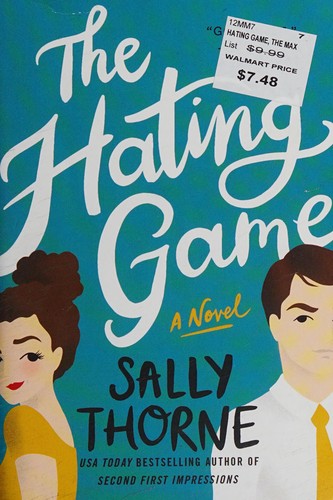
Talk to The Hating Game like its author wrote you back.
Get the ideas that fit your life — not generic summaries.
- Chat with the book
- Audiobook-style main ideas
- Adapts to your life and goals
- Helps you take action
The Hating Game, in detail
Lucy Hutton and Joshua Templeman are co-assistants to the joint CEOs of a publishing company formed by a merger, sharing a tiny office, facing each other across identical desks, and conducting an elaborate cold war of small competitions and veiled hostilities. Lucy is warm, compulsively accommodating, and has built an entire career out of being liked. Joshua is cold, precise, devastating in meetings, and apparently incapable of normal human expression. They have been playing the hating game for months when the novel opens, and the reader immediately understands — even if Lucy doesn't — what that game is really about.
The Hating Game is the novel that revived the enemies-to-lovers romance as a serious commercial category. Thorne's achievement is making the slow burn feel genuinely earned: Lucy and Joshua's antagonism has the specific texture of two people who have been studying each other obsessively, and the gradual revelation that obsession is mutual is the novel's primary pleasure. The office setting — confined, hierarchical, rule-governed — creates exactly the right kind of pressure cooker.
Thorne writes from Lucy's perspective with comic skill; Lucy's internal monologue is funny, self-aware, and chronically unreliable about Joshua's motives. The novel is almost entirely driven by interiority — what Lucy notices, overthinks, and misreads. Joshua's emotional opacity is maintained with discipline; we only understand him through the cracks, which makes each crack more significant. The physical tension, when it finally arrives, feels like weather breaking.
This is genre romance done at a high level of craft. It has a clear premise, sharp execution, good comedy, and an emotionally satisfying arc. It does not have literary ambiguity or complex moral stakes. Readers who dislike genre conventions — the particular escalation rhythms of romance, the guaranteed resolution — won't be converted here. Readers who like romance novels and haven't read this one are missing something.
The big ideas
- 1.
Thorne uses the physical confinement of the shared office brilliantly — two people who cannot escape each other without quitting creates a pressure that the novel exploits for both comedy and tension.
- 2.
Lucy's compulsive people-pleasing is presented as both charming and problematic — the novel uses her relationship with Joshua to examine what she costs herself by always accommodating others.
- 3.
Joshua's emotional opacity is the novel's structural bet: Thorne keeps him opaque long enough that the reader and Lucy are genuinely uncertain what he feels, and the revelation lands with force.
