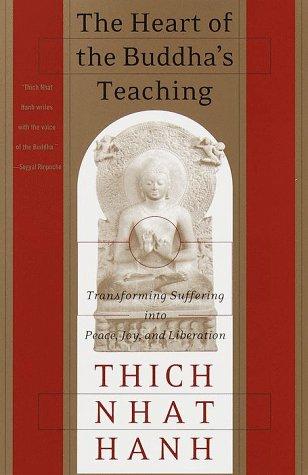
Talk to The Heart of the Buddha's Teaching like its author wrote you back.
Get the ideas that fit your life — not generic summaries.
- Chat with the book
- Audiobook-style main ideas
- Adapts to your life and goals
- Helps you take action
The Heart of the Buddha's Teaching, in detail
The Heart of the Buddha's Teaching is Thich Nhat Hanh's comprehensive introduction to core Buddhist teachings, written with the warmth and accessibility that characterize all of his work. The book systematically covers the Four Noble Truths, the Noble Eightfold Path, the Two Truths, the Three Dharma Seals, and the 37 Aids to Awakening, always grounding abstract doctrine in concrete practice and daily life. It is not an academic survey but a teaching manual — designed to be lived, not merely understood.
Nhat Hanh's signature contribution is his teaching on "interbeing" — his term for dependent origination, the Buddhist principle that all phenomena arise in mutual dependence and contain one another. A sheet of paper contains the cloud that watered the tree, the logger who cut it, the bread that fed the logger, and the sun. Nothing exists independently; everything "inter-is." This is not a metaphysical abstraction but a practice of perception: when you see interbeing clearly, separation and alienation dissolve, and compassion arises naturally.
The Four Noble Truths are presented not as a grim diagnosis but as a path of transformation. Suffering is real, but it is also a teacher. The causes of suffering — craving, aversion, and delusion — are identifiable and workable. Cessation is possible not as an escape from life but as a transformation of how we relate to it. And the Eightfold Path is a living practice, not a list to memorize: right speech means speaking only what is true and kind; right livelihood means work that does not cause harm; right mindfulness means maintaining clear, gentle attention to present experience.
The book's greatest strength is its tone. Nhat Hanh never lectures or condescends; he writes as if sitting with the reader, pointing gently at what is already available. His approach to Buddhist doctrine is consistently engaged — he explicitly connects the teaching to contemporary issues including war, injustice, and environmental destruction — but never polemical. The result is a book that manages to be both a complete introduction to classical Buddhist doctrine and a guide to practical transformation.
The big ideas
- 1.
Interbeing — Nhat Hanh's term for dependent origination — means all phenomena arise in mutual dependence; nothing exists independently or in isolation.
- 2.
Suffering is a teacher: understanding its causes (craving, aversion, and delusion) is the beginning of transformation, not grounds for despair.
- 3.
The Four Noble Truths are not a grim diagnosis but a dynamic path: recognizing suffering, understanding its causes, experiencing cessation, and practicing the way.
