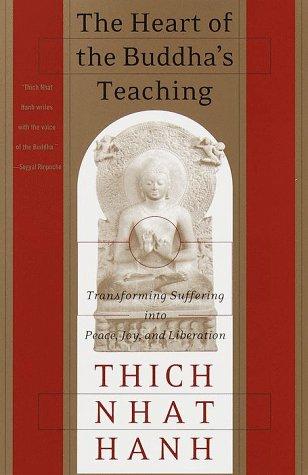
The Heart of the Buddha's Teaching by Thich Nhat Hanh is a 1998 religion & spirituality book about buddhism, suffering, mindfulness. Interbeing — Nhat Hanh's term for dependent origination — means all phenomena arise in mutual dependence; nothing exists independently or in isolation.
Summary
The Heart of the Buddha's Teaching is Thich Nhat Hanh's comprehensive introduction to core Buddhist teachings, written with the warmth and accessibility that characterize all of his work. The book systematically covers the Four Noble Truths, the Noble Eightfold Path, the Two Truths, the Three Dharma Seals, and the 37 Aids to Awakening, always grounding abstract doctrine in concrete practice and daily life. It is not an academic survey but a teaching manual — designed to be lived, not merely understood.
Nhat Hanh's signature contribution is his teaching on "interbeing" — his term for dependent origination, the Buddhist principle that all phenomena arise in mutual dependence and contain one another. A sheet of paper contains the cloud that watered the tree, the logger who cut it, the bread that fed the logger, and the sun. Nothing exists independently; everything "inter-is." This is not a metaphysical abstraction but a practice of perception: when you see interbeing clearly, separation and alienation dissolve, and compassion arises naturally.
The Four Noble Truths are presented not as a grim diagnosis but as a path of transformation. Suffering is real, but it is also a teacher. The causes of suffering — craving, aversion, and delusion — are identifiable and workable. Cessation is possible not as an escape from life but as a transformation of how we relate to it. And the Eightfold Path is a living practice, not a list to memorize: right speech means speaking only what is true and kind; right livelihood means work that does not cause harm; right mindfulness means maintaining clear, gentle attention to present experience.
The book's greatest strength is its tone. Nhat Hanh never lectures or condescends; he writes as if sitting with the reader, pointing gently at what is already available. His approach to Buddhist doctrine is consistently engaged — he explicitly connects the teaching to contemporary issues including war, injustice, and environmental destruction — but never polemical. The result is a book that manages to be both a complete introduction to classical Buddhist doctrine and a guide to practical transformation.
Talk to The Heart of the Buddha's Teaching like its author wrote you back.
Get the ideas that fit your life — not generic summaries.
- Chat with the book
- Audiobook-style main ideas
- Adapts to your life and goals
- Helps you take action
Key takeaways
- 1.
Interbeing — Nhat Hanh's term for dependent origination — means all phenomena arise in mutual dependence; nothing exists independently or in isolation.
- 2.
Suffering is a teacher: understanding its causes (craving, aversion, and delusion) is the beginning of transformation, not grounds for despair.
- 3.
The Four Noble Truths are not a grim diagnosis but a dynamic path: recognizing suffering, understanding its causes, experiencing cessation, and practicing the way.
- 4.
The Noble Eightfold Path is a living practice integrated into daily life, not a list of rules or a sequence to complete before 'real' practice begins.
- 5.
Right mindfulness means maintaining gentle, non-reactive awareness of present experience across all activities, not only in formal meditation.
- 6.
The Three Dharma Seals — impermanence, non-self, and nirvana — are markers of genuine Buddhist teaching and correctives to the three poisons of permanence-thinking, self-grasping, and suffering.
- 7.
Right speech is among the most practically demanding elements of the path: speaking only what is true, kind, and timely significantly transforms relationship.
- 8.
Engaged Buddhism connects meditation practice to social responsibility: mindfulness and compassion are not escapes from the world but capacities for responding to it effectively.
Discussion questions
Use these on your own, with a book club, or as chat starters in Superbook. Book club version, ready to copy or print →
- 1.
Nhat Hanh's concept of interbeing says everything contains everything else in mutual dependence. Can you identify three things in your immediate environment that 'contain' distant causes and conditions?
- 2.
He presents suffering as a teacher rather than an enemy. What has a recent difficulty in your life been trying to teach you?
- 3.
Right speech — speaking only what is true, kind, and timely — is deceptively simple. Which of those three conditions do you find hardest to meet simultaneously?
- 4.
The book argues that cessation of suffering is not escape from life but transformation of how we relate to it. What would that transformation look like in a specific area of your life?
- 5.
Nhat Hanh connects mindfulness practice to social and environmental engagement. Is that connection persuasive, or does it seem like an add-on to the original teaching?
- 6.
Right livelihood asks whether your work causes harm. How honestly have you examined your own livelihood by that standard?
- 7.
The Three Dharma Seals — impermanence, non-self, nirvana — are described as marks of authentic teaching. Does that provide a useful filter for evaluating spiritual teachings in general?
- 8.
Nhat Hanh's voice is remarkably warm and non-confrontational compared to most philosophical or theological writing. Does that tone help the teaching land, or does it soften things that need sharpness?
- 9.
The book describes the Eightfold Path as integrated rather than sequential — all eight elements are practiced simultaneously. Is that realistic, or does it require an advanced practitioner?
- 10.
Interbeing has political implications: environmental harm harms the self because the self is not separate from the environment. Is that a compelling argument for environmental ethics?
- 11.
How would your day change if you maintained even a fraction of the mindfulness Nhat Hanh describes? What would be the first thing you'd notice?
- 12.
Nhat Hanh survived the Vietnam War and was exiled from his home country for forty years. How does that biographical context shape the teaching in this book?
Themes
Frequently asked questions
-
Is this a good introduction to Buddhism?
Yes, especially for readers who want a warm, accessible entry point rather than a scholarly one. It covers the core doctrines comprehensively while grounding everything in practice. Walpola Rahula's What the Buddha Taught is more scholarly and more closely grounded in Pali sources.
-
What is interbeing?
Thich Nhat Hanh's term for dependent origination (pratityasamutpada) — the Buddhist principle that all phenomena arise in mutual dependence and contain each other. It is both a metaphysical claim and a perceptual practice that, when cultivated, naturally generates compassion.
-
What is engaged Buddhism?
Nhat Hanh's term for a Buddhism that connects inner practice to social and political engagement. Meditation is not a retreat from the world but a capacity for responding to its suffering. He developed the concept in response to the Vietnam War.
-
How does this compare to other Thich Nhat Hanh books?
Peace Is Every Step is shorter and more accessible, focused on everyday mindfulness. This book is more systematic, covering the full doctrinal framework. Both are characteristic of his voice, but this one is the more complete overview.
-
Do I need a meditation practice to benefit from this book?
No, but Nhat Hanh consistently encourages readers to practice. The book describes specific techniques — mindful breathing, walking meditation, deep listening — that can be started immediately. The teachings are most useful when tested in practice.