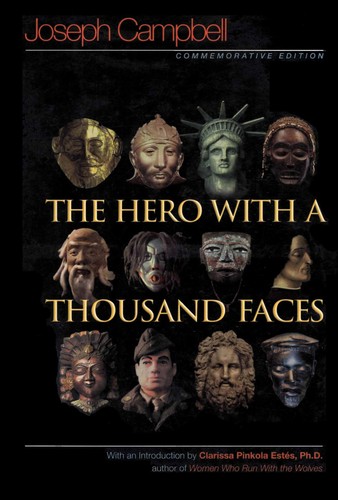
Talk to The Hero with a Thousand Faces like its author wrote you back.
Get the ideas that fit your life — not generic summaries.
- Chat with the book
- Audiobook-style main ideas
- Adapts to your life and goals
- Helps you take action
The Hero with a Thousand Faces, in detail
The Hero with a Thousand Faces, first published in 1949, is Joseph Campbell's account of the monomyth — his term for the single underlying story structure that, he argues, appears across the world's mythologies, folk tales, and religious narratives. The hero departs from the ordinary world, undergoes a series of trials in a special realm, achieves a transformation, and returns with something — knowledge, power, or a boon — that benefits the community. Campbell identifies this three-part structure (separation, initiation, return) in stories from ancient Sumer to modern psychology, from Prometheus to the Buddha to the Christian crucifixion.
The book is as much a work of depth psychology as of comparative mythology. Campbell draws heavily on Freud and especially Jung, treating mythological figures as projections of psychological forces. The hero's journey outward is also a journey inward: the dragons and helpers he encounters correspond to the unconscious contents — fears, desires, shadow material — that must be confronted for the personality to develop. The goal of the journey is not conquest but transformation: the hero who returns is not the same person who left.
Campbell's argument is that these stories matter not as entertainment or cultural artifact but as maps. They show what psychological work adulthood requires. They encode initiatory patterns that prepare individuals for the successive deaths and rebirths that characterize a fully lived life: leaving home, taking on a vocation, accepting mortality, achieving some form of spiritual maturity. In cultures with functioning mythological systems, these patterns are transmitted through ritual. In modern Western culture, Campbell argues, they persist mainly in degraded and unrecognized forms.
The scholarship is vast and the argument is broad to the point of controversy. Later scholars have criticized Campbell's tendency to flatten genuine differences among traditions in search of a universal structure. The book's influence, however — on George Lucas, on narrative theory, on storytelling practice across film, literature, and game design — is difficult to overstate. It rewards engagement for anyone willing to question as well as absorb.
The big ideas
- 1.
The monomyth is the single underlying story structure Campbell identifies across world mythology: separation from the ordinary world, initiation through trials, and return with a boon.
- 2.
The hero's journey is simultaneously an outer adventure and an inner psychological transformation. The monsters and helpers encountered correspond to unconscious contents that must be faced.
- 3.
Mythology encodes the initiatory patterns that cultures transmit to help individuals navigate the psychological passages of adult life: departure, transformation, and return.
