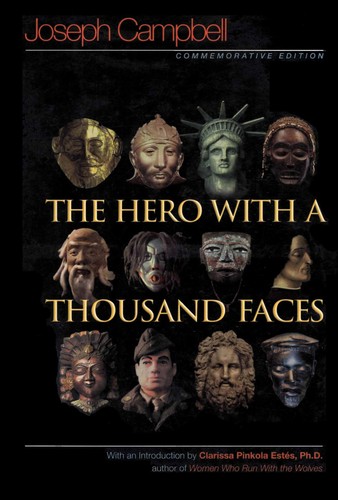
The Hero with a Thousand Faces by Joseph Campbell is a 1949 philosophy book about hero's journey, mythology, transformation. The monomyth is the single underlying story structure Campbell identifies across world mythology: separation from the ordinary world, initiation through trials, and return with a boon.
Summary
The Hero with a Thousand Faces, first published in 1949, is Joseph Campbell's account of the monomyth — his term for the single underlying story structure that, he argues, appears across the world's mythologies, folk tales, and religious narratives. The hero departs from the ordinary world, undergoes a series of trials in a special realm, achieves a transformation, and returns with something — knowledge, power, or a boon — that benefits the community. Campbell identifies this three-part structure (separation, initiation, return) in stories from ancient Sumer to modern psychology, from Prometheus to the Buddha to the Christian crucifixion.
The book is as much a work of depth psychology as of comparative mythology. Campbell draws heavily on Freud and especially Jung, treating mythological figures as projections of psychological forces. The hero's journey outward is also a journey inward: the dragons and helpers he encounters correspond to the unconscious contents — fears, desires, shadow material — that must be confronted for the personality to develop. The goal of the journey is not conquest but transformation: the hero who returns is not the same person who left.
Campbell's argument is that these stories matter not as entertainment or cultural artifact but as maps. They show what psychological work adulthood requires. They encode initiatory patterns that prepare individuals for the successive deaths and rebirths that characterize a fully lived life: leaving home, taking on a vocation, accepting mortality, achieving some form of spiritual maturity. In cultures with functioning mythological systems, these patterns are transmitted through ritual. In modern Western culture, Campbell argues, they persist mainly in degraded and unrecognized forms.
The scholarship is vast and the argument is broad to the point of controversy. Later scholars have criticized Campbell's tendency to flatten genuine differences among traditions in search of a universal structure. The book's influence, however — on George Lucas, on narrative theory, on storytelling practice across film, literature, and game design — is difficult to overstate. It rewards engagement for anyone willing to question as well as absorb.
Talk to The Hero with a Thousand Faces like its author wrote you back.
Get the ideas that fit your life — not generic summaries.
- Chat with the book
- Audiobook-style main ideas
- Adapts to your life and goals
- Helps you take action
Key takeaways
- 1.
The monomyth is the single underlying story structure Campbell identifies across world mythology: separation from the ordinary world, initiation through trials, and return with a boon.
- 2.
The hero's journey is simultaneously an outer adventure and an inner psychological transformation. The monsters and helpers encountered correspond to unconscious contents that must be faced.
- 3.
Mythology encodes the initiatory patterns that cultures transmit to help individuals navigate the psychological passages of adult life: departure, transformation, and return.
- 4.
The threshold guardian — the force that blocks the hero's departure — represents the ordinary world's resistance to change. Crossing the threshold requires confronting one's own attachment to the familiar.
- 5.
The atonement with the father is one of the journey's central ordeals: coming to terms with the authority and mortality of the generational line one inherits, and eventually one's own.
- 6.
The boon — the elixir or knowledge the hero brings back — is only of value if it can be translated into terms the community can use. The return is as demanding as the departure.
- 7.
Modern Western culture lacks functional rites of initiation. Without them, the archetypal energies that myth is designed to channel find no constructive outlet.
- 8.
Myth is not wrong science or false history. It operates at the level of symbol, not fact, and its psychological truth is independent of its literal falsity.
Discussion questions
Use these on your own, with a book club, or as chat starters in Superbook. Book club version, ready to copy or print →
- 1.
Campbell argues that the same story structure underlies myths from radically different cultures. Does the evidence he presents convince you, or does the comparison feel forced at points?
- 2.
Map the hero's journey onto a major transition in your own life. Where was the threshold? Who were the helpers and threshold guardians? What was the boon?
- 3.
Campbell treats the monsters in myth as projections of psychological contents — fear, desire, shadow. Which monsters in the stories you find most compelling correspond to real psychological material for you?
- 4.
The return is often harder than the departure. What does it mean to bring back what you have learned rather than simply escaping to a special realm permanently?
- 5.
Campbell uses Freud and Jung extensively. How does treating mythological figures as psychological projections change your relationship to the stories?
- 6.
Modern Western culture lacks formal initiation rites. What has substituted for them in your own experience? How adequate have those substitutes been?
- 7.
Critics argue that Campbell flattens genuine cultural difference in pursuit of a universal structure. Does that criticism apply fairly to the book as you read it?
- 8.
Which aspect of the hero's journey do you find most psychologically compelling: the departure, the trials and transformation, or the return and its difficulties?
- 9.
Campbell argues that the hero's goal is not to conquer but to be transformed. How does that reframing change what you look for in the stories you value?
- 10.
The book was written in 1949. Which parts feel dated to you, and which parts feel as fresh as when they were written?
- 11.
George Lucas credited Campbell with providing the structural foundation for Star Wars. Watching or re-watching that film, how clearly do you see the monomyth operating?
- 12.
If myth encodes what psychological work adulthood requires, what is the myth you most need right now? What journey does your situation call for?
Themes
Frequently asked questions
-
What is the hero's journey?
Campbell's term for the three-part narrative structure he identified across world mythology: the hero departs from ordinary life, undergoes trials and transformation in a special realm, and returns with something of value to the community. Campbell called this universal structure the monomyth.
-
Is The Hero with a Thousand Faces worth reading?
Yes, particularly if you are interested in mythology, narrative structure, or Jungian psychology. It is a dense and ambitious book. Readers should be aware of the legitimate scholarly criticisms of its comparative method — but even critics acknowledge its cultural impact and the power of its central argument.
-
How long does it take to read The Hero with a Thousand Faces?
Around five to six hours at average reading pace, though many readers take longer. The book is dense with mythological references and rewards slow reading. The introduction is the clearest statement of the argument.
-
Who should read The Hero with a Thousand Faces?
Writers, filmmakers, and storytellers looking for structural frameworks; students of mythology, religion, or depth psychology; and anyone curious about why certain stories — across wildly different cultures — seem to carry the same emotional weight.
-
What are the main criticisms of The Hero with a Thousand Faces?
The most serious is that Campbell forces diverse mythologies into a single template, obscuring genuine cultural and religious differences. Critics also note that the monomyth reflects a particular masculine and Western orientation. Donna Haraway, Wendy Doniger, and others have made these arguments at length.