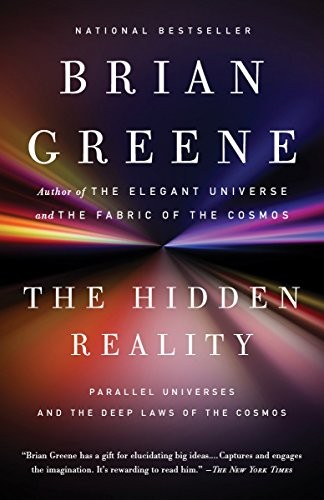
Talk to The Hidden Reality: Parallel Universes and the Deep Laws of the Cosmos like its author wrote you back.
Get the ideas that fit your life — not generic summaries.
- Chat with the book
- Audiobook-style main ideas
- Adapts to your life and goals
- Helps you take action
What it argues
Brian Greene, a string theorist at Columbia University and the author of The Elegant Universe, devoted this book to a single sprawling question: does our universe have company? The Hidden Reality is a systematic survey of nine distinct multiverse proposals — theories arising from different corners of modern physics and mathematics that independently suggest our universe may be one of many. Greene's goal is not to advocate for any single theory but to show that the multiverse idea keeps appearing in physics whether physicists want it or not.
The nine varieties of multiverse Greene examines include the quilted multiverse (arising from infinite space and a finite set of possible particle configurations), the inflationary multiverse (from eternal cosmic inflation producing bubble universes), the brane multiverse (from string theory's higher-dimensional braneworld scenarios), the cyclic multiverse (from colliding membranes), the landscape multiverse (from string theory's enormous set of possible vacuum states), the quantum multiverse (from Everett's many-worlds interpretation), the holographic multiverse, the simulated multiverse, and the ultimate ensemble — the mathematical multiverse.
What it gets right
- 1.
The multiverse is not a single theory but a family of distinct proposals, each arising from a different area of physics, that independently suggest our universe may be one of many.
- 2.
Eternal inflation predicts that quantum fluctuations in the early universe would create an infinite number of bubble universes, each potentially with different physical constants.
- 3.
String theory's landscape contains roughly 10⁵⁰⁰ possible vacuum states, each corresponding to a different universe with different physical constants. Some physicists see this as explaining why our universe seems fine-tuned.
What it covers
Who wrote it
Brian Greene is a theoretical physicist and string theorist at Columbia University, where he co-founded the World Science Festival. He is the author of The Elegant Universe, The Fabric of the Cosmos, and Until the End of Time, as well as a children's picture book on the Higgs boson. Greene is one of the most visible science communicators in the United States, having hosted PBS documentary series based on his books and lectured widely to general audiences. His research focuses on string theory, extra dimensions, and the nature of spacetime.
